
I. The Short Version: Key Takeaways
If your company leases office space in the Puget Sound region (King, Pierce and Snohomish counties), you are in the strongest position tenants have held in a generation. About 25% of the region’s multi-tenant office space sits empty, and in the Seattle central business district (CBD), the figure is about 35%.
But the market has stopped falling. Leasing is at its best pace since 2021, sublease space has shrunk to about half its 2020 share, and almost nothing new is being built. The clearance sale is still on, but the racks are getting thinner. For business leaders, the question is no longer whether you have leverage. It is where you have it, and how long it will last.
II. Office Vacancy by Submarket: One Region, Very Different Deals
“Seattle office” is not one market. A company seeking 15,000 SF could face 35% vacancy in one neighborhood and 3% a short drive away, and its leasing strategy should change accordingly.
| Submarket | Vacancy (Q3 2026) | Asking Rent Trend (vs. a Year Ago) |
|---|---|---|
| Seattle CBD | 35% | Flat to down; landlords offering large free-rent and build-out packages |
| Pioneer Square/ Waterfront | 33% | Not rising; landlords competing for tenants |
| Belltown/ Denny Regrade | 33% | Not rising; landlords competing for tenants |
| Queen Anne/ Magnolia | 35% | Lowest asking rents in Seattle; landlords competing for tenants |
| I-90 Corridor (Eastside) | 42% | Not rising; some older buildings being converted to housing |
| Bothell/ Suburban Bellevue | 20% | Not rising; large blocks of sublease space available below direct rents |
| Lake Union/ South Lake Union | 22% | Steady; strongest tenant demand of any Seattle neighborhood |
| Bellevue CBD | 24% | Rising in the newest towers; older buildings more flexible on terms |
| Renton/ Tukwila | 23% | Up modestly; newest buildings about 40% vacant and flexible on terms, older buildings nearly full |
| Tacoma CBD | 14% | Up about 2%; best buildings about 26% vacant and flexible on terms |
| Kirkland | 9% | Up about 4%; a sought-after market where early planning pays off |
| Northgate/ North Seattle | 8% | Up about 2.5%; stable and well occupied, so planning ahead pays off |
| Edmonds/ Lynnwood | 8% | Up about 3%; stable market with good value and light rail access |
| Mill Creek/ Woodinville | 3% | Up about 1.7%; modest rent growth in a stable, nearly full market |
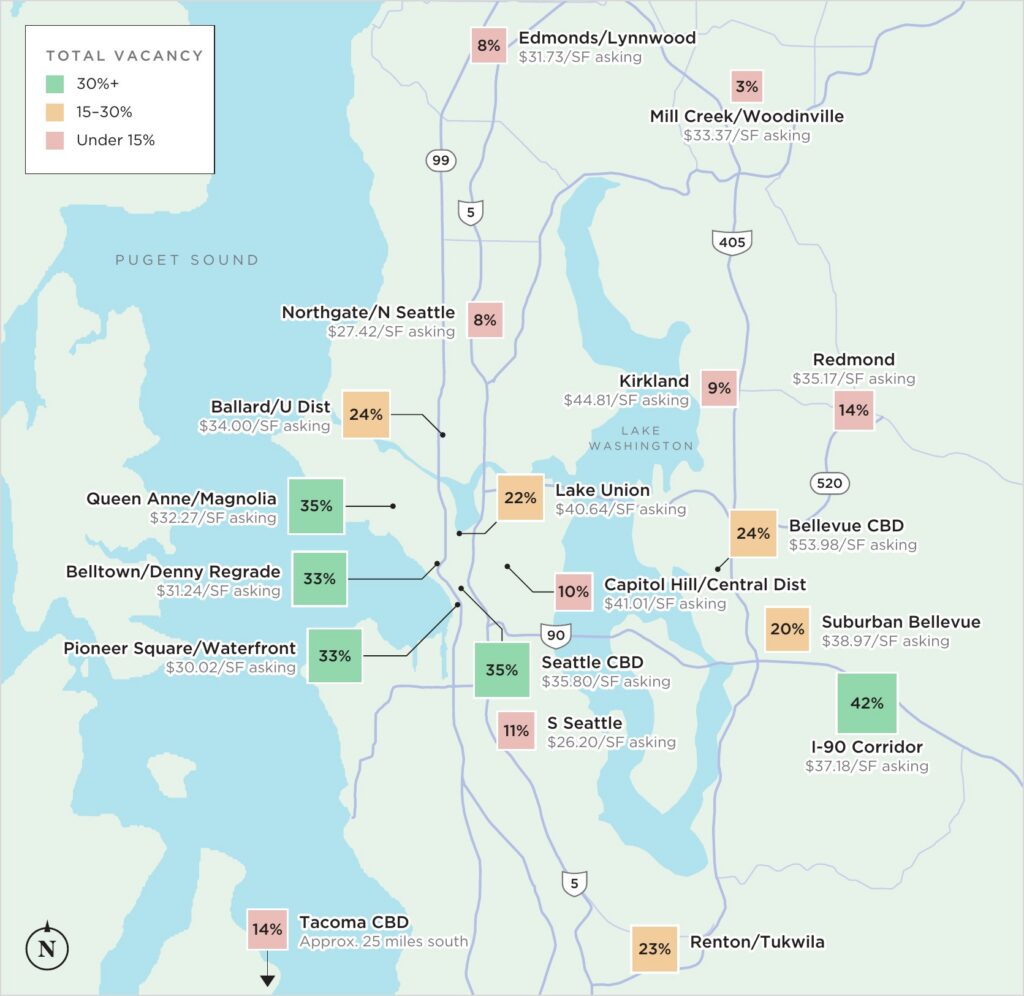
Maximum Leverage: 30%+
Seattle CBD, Pioneer Square/Waterfront, Belltown/Denny Regrade, Queen Anne/Magnolia and I-90 Corridor. Landlords are competing hard—expect aggressive concessions, generous TI and flexible terms.
Strong Leverage: 15-30%
Bellevue CBD, Lake Union, Ballard/U Dist, Suburban Bellevue and Renton/Tukwila. Ample options give tenants real room to drive rate, concessions and term.
Strategy Wins: Under 15%
Kirkland, Redmond, Edmonds/Lynnwood, Mill Creek/Woodinville, Capitol Hill/Central Dist, Northgate/N Seattle, S Seattle and Tacoma CBD. Fewer listings reward deep market intel and off-market access—our specialty.
III. Downtown Seattle Office: The Clearance Aisle
Downtown Seattle’s office vacancy rate is about 35%, among the highest in the region. Walk down Third Avenue and you can practically hear the empty floors. Some of the CBD’s best-known towers are more than half available, and 1111 Third is more than 80% available. Pioneer Square tells the same story with more brick: about 33% vacant, with The Jack entirely empty.
A handful of buildings, led by West8, Madison Centre and Rainier Square, are winning most of the big deals. Everyone else is competing hard, and it shows up in the offer: long free-rent periods, generous build-out money (tenant improvement allowances) and flexibility like termination and expansion rights. Premium sublease space is another quiet bargain for companies comfortable with a shorter term. And ownership matters. Plaza 600 recently traded for about $60 per square foot, and a landlord with that cost basis can price space aggressively. Just make sure any landlord can actually fund the improvements it promises.
IV. Where the New Demand is Landing: South Lake Union and Bellevue
AI and tech companies are carrying much of the region’s leasing, but they are concentrated in two places. In South Lake Union, Anthropic is growing to roughly 163,000 SF at Dexter Yard. In downtown Bellevue, Crusoe, Lambda, OpenAI, Uber and Databricks have all signed leases, and top Class A asking rents sit around $69 per square foot. If your company wants the same new, amenity-rich buildings these firms want, expect real competition and start early.
Even downtown Bellevue is about 24% vacant, though, and Meta and Bungie just put large blocks of sublease space on the market. A move-in-ready sublease in a Bellevue tower may be the best value on the Eastside. Step outside the core and it gets easier still: the I-90 Corridor is 42% vacant, and Bothell and Suburban Bellevue sit around 20%.
V. The South Sound: Renton and Tacoma
Renton (about 23% vacant) just landed the region’s biggest office lease of the year, with Providence Health taking two full buildings at the former Longacres campus. The rest of the market is split: older space is tight, while the newest towers are still close to 40% vacant. That makes Renton a rare chance to get new space near I-405 and SeaTac at a fraction of Bellevue pricing.
Tacoma’s downtown is steady and affordable, at about 14% vacant with rents near $30 per square foot. Its best buildings carry the most empty space, so tenants there should push for better improvements rather than lower rent.
VI. The Tight Suburbs: Kirkland, Northgate, Edmonds and Mill Creek
Here is the part of the market that rarely makes the headlines. Kirkland (9%), Northgate (8%), Edmonds/Lynnwood (8%) and Mill Creek/Woodinville (3%) are quietly running out of room, and nobody is building anything new. Kirkland rents rose about 4% over the past year. In all of Mill Creek/Woodinville, only about 43,000 SF is listed as available.
If your business is based in one of these markets, start 18 to 24 months before your lease expires, use your landlord’s desire to avoid a vacancy to lock in an early renewal and consider buying. In Mill Creek/Woodinville, buildings are trading near $300 per square foot, and owning can beat renting when there is nothing to rent.
VII. Office Lease Strategy: What Smart Tenants Are Doing Now
Most landlords would rather give you a year of free rent than lower the number on the lease, because the building’s value depends on the face rate. Once you understand that, the strategy gets clearer.
Compare the whole deal, not the rent. Free months, build-out money and flexibility can make two offers with the same asking rate differ by 20% or more in real cost.
Size build-out money to today’s prices. Construction costs rose about 9% over the past year. Ask for a turnkey build-out or an allowance based on a current contractor estimate.
Check that your landlord can pay. With interest rates high, some owners are stretched. Protect yourself with rent offset rights if promised improvement money does not appear.
Buy flexibility while it is cheap. Termination options, expansion rights and the ability to give back space cost landlords less in a soft market. Ask for them.
Lock in long-term value. If you plan to stay, capture today’s pricing for 10 years, with renewal options at fixed or capped rates.
VIII. The Bottom Line: Planning for 2027 and 2028 Lease Expirations
Only about 139,000 SF of speculative office space is under construction across the entire region, so today’s surplus is the last big supply of space this cycle. In downtown Seattle and much of the Eastside, you hold the cards. In Renton and Tacoma, the best deals are in the newest buildings. In the tight suburbs, the advantage goes to whoever starts first.
If your lease expires in 2027 or 2028, now is the time to start the conversation. The best concessions of this cycle are on the table today, and they will not stay there forever. Hughes Marino works for occupiers of space, not landlords, and our Seattle team can show you where your leverage is strongest.
Frequently Asked Questions
As of the third quarter of 2026, the Seattle central business district (CBD) office vacancy rate is about 35%, and about 25% of multi-tenant office space across the Puget Sound region is vacant. Vacancy varies widely by submarket, from about 42% in the I-90 Corridor to about 3% in Mill Creek/Woodinville.
The Puget Sound office market has stopped declining. Leasing is at its strongest pace since 2021, sublease space has fallen to about half its 2020 share and only about 139,000 SF of speculative office space is under construction. Tenants still hold strong leverage, but the surplus of available space is starting to shrink.
The tightest office markets in the region are Mill Creek/Woodinville (about 3% vacant), Northgate/North Seattle (8%), Edmonds/Lynnwood (8%) and Kirkland (9%). Almost no new office space is being built in these suburbs, so tenants there should start planning 18 to 24 months before their lease expires.
Top Class A asking rents in downtown Bellevue are around $69 per square foot as of the third quarter of 2026, and rents are rising in the newest towers. Overall vacancy in the Bellevue CBD is about 24%, and new sublease space from Meta and Bungie gives tenants lower-cost options in Bellevue towers.
AI and tech companies are driving much of the region’s demand. Anthropic is expanding to roughly 163,000 SF at Dexter Yard in South Lake Union, while Crusoe, Lambda, OpenAI, Uber and Databricks have signed leases in downtown Bellevue. In Renton, Providence Health signed the region’s biggest office lease of the year, taking two full buildings at the former Longacres campus.
Downtown Seattle landlords are offering long free-rent periods, generous tenant improvement allowances and flexibility such as termination and expansion rights. Most landlords would rather give free rent than lower the face rate, because a building’s value is tied to the rent written in the lease. That means tenants should compare the total cost of each offer, not just the asking rate.
Now. The best concessions of this cycle are available today, and with almost no new office space under construction, today’s surplus is the last large supply of space this cycle. In tight suburban markets such as Kirkland and Mill Creek/Woodinville, tenants should start 18 to 24 months before their lease expires.
Market statistics provided by CoStar Group.