
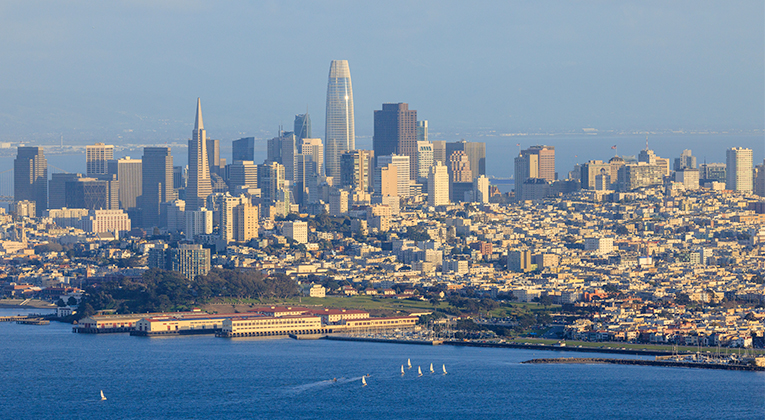
San Francisco’s office market recovery continued in the second quarter of 2026 after a record quarter to start the year. Tenants leased 2.8M SF over the past three months, bringing year-to-date leasing to 7M SF. Net absorption slowed to roughly half the first-quarter pace, but year-to-date positive absorption reached 2.9M SF, already ahead of all of 2025. The San Francisco Chronicle reported that citywide vacancy fell about 5 percentage points year over year to roughly 29.7%, down from 34.7% a year ago, the fastest decline of any major market in the country. The throughline remains the same as it has been for the past 18 months: artificial intelligence companies are the primary engine of the recovery, and their footprints are no longer confined to a handful of trophy buildings and suites under 10,000 SF.
Notable Leases Reported in Q2 2026
| Tenant | Address | Size (SF) | Deal Type |
| City of San Francisco | 1455 Market Street | 900,000 | Expansion (502,000 SF) |
| Amazon Robotics | 650 Townsend Street | 250,000 | New location (expected to close late summer 2026) |
| PwC | 405 Howard Street | 196,356 | Renewal |
| Together AI | 2 Henry Adams Street | 150,000 | Relocation/expansion |
| Ripple | 600 Battery Street | 124,547 | Renewal |
| Brex | 270 Brannan Street | 116,853 | Expansion |
| Planet Labs PBC | 645 Harrison Street | 112,000 | Expansion/renewal (40,000 SF) |
| LangChain | 303 Second Street | 70,000 | Sublease relocation/expansion |
| Assort Health | One Market Plaza | 62,400 | Relocation/expansion |
| Mercor | 181 Fremont Street | 59,000 | Sublease expansion (34,000 SF) |
| Lightspeed Venture Partners | 149 New Montgomery Street | 42,000 | Relocation/expansion |
| Patreon | 180 Howard Street | 35,000 | Relocation/downsize |
| Fal.ai | 300 Mission Street | 29,000 | Sublease/expansion |
Demand Reaches a Record High, Led by AI
AI companies have accounted for roughly 30% of leasing activity since 2023 and more than three-quarters of net absorption, making the sector the primary driver of vacancy reduction. Tenant requirements in the market have climbed to a record 8.9M SF, up from the previous high of 8.2M SF set just last quarter. Of that demand, 53 AI companies are actively seeking a combined 3.1M SF, and 11 of the 30 tenants in the market for spaces larger than 100,000 SF are AI companies.
New Entrants Are Filling in Outside the Financial District Core
Showplace Square, once a symbol of the market’s post-pandemic uncertainty, is emerging as a distinct AI and robotics cluster on the southern edge of SoMa. Amazon Robotics is reportedly in the final stages of negotiating a 250,000 SF direct lease at 650 Townsend Street, a former piece of Airbnb’s sprawling campus. The building’s owner, Beacon Capital Partners, is working to terminate remaining subleases held by departed tenants to accommodate the deal. Amazon Robotics would join Scale AI, which recently took roughly 180,000 SF in the same building.
In the northern part of the city, the North Waterfront, which had experienced significantly more vacancy than Jackson Square over the past six years, is now benefiting from the volume of companies that are drawn to its accessibility for employees based in North Beach, Pacific Heights and the Marina, as well as commuters from Marin. Jamestown’s four-building Waterfront Plaza project, which reached 66% availability in 2024, is now only 22% available.
Bifurcated Recovery Continues by Building and Location
The recovery remains uneven. Top-tier and recently repositioned buildings are capturing most of the market’s positive absorption, while older, less competitive properties continue to account for a disproportionate share of available space. One Market Plaza’s Spear Tower, for example, has signed four new leases totaling almost 150,000 SF so far in 2026, including Assort Health and three law firms, and is now 67% leased following a renovation program. The nearby 181 Fremont Street tower is nearly full for the first time since Meta vacated its space. Inventory in Jackson Square remains limited, and the Presidio is essentially fully leased.
At the same time, newer buildings that opened into a weak market are still working to fill up. The 650,000 SF tower at 415 Natoma Street, known as 5M, changed hands this quarter through a discounted deed-in-lieu-of-foreclosure transaction after its developer Brookfield’s lender took a loss; the new owners, the Meridian Group and Fenway Capital Advisors, take over stewardship of the Central SoMa building, which remains largely vacant apart from a single tenant. The recovery, while broad, is still concentrated in well-located, highly amenitized buildings. Proximity to the Embarcadero, Financial District BART stations and Caltrain remains the most sought-after attribute, while submarkets like Yerba Buena, Central and West SoMa, and the Mid-Market remain considerably less desired.
Government and Corporate Anchors Add Stability
The largest single lease signed so far in 2026 came not from a technology company but from the City of San Francisco, which finalized a discounted, long-term lease for 502,000 SF at 1455 Market Street. The deal brings the City’s total footprint in the building to more than 900,000 SF. The City intends to consolidate several departments currently housed in older, seismically vulnerable buildings. It is the largest office lease in San Francisco since Facebook’s 756,000 SF commitment to Park Tower in 2018.
Renewals also contributed meaningfully to quarterly activity, with Ripple recommitting to its 124,547 SF full-building lease at 600 Battery Street and PwC renewing for 196,356 SF at 405 Howard Street, both signals that established tenants are choosing to stay put rather than downsize.
Investment Sales Follow Leasing Momentum
Improved leasing fundamentals are attracting capital back into San Francisco office real estate, which is a much-needed continuing development as “Zombie Buildings” remain a major drag on the leasing market in the city. “Zombie Buildings” are properties that are underwater with non-performing debt, which makes investing in spec suites, providing tenant improvement allowances, or even leasing space nearly impossible. Approximately 20 buildings are currently pending sale or on the market, which tenants should welcome as an opportunity to bring more new and improved spaces to the city’s leasable office inventory. Recent examples include the discounted transfers of 415 Natoma Street and 225 Bush Street. While not a distressed asset by most measures, a $700 million acquisition of the Transamerica Pyramid and its two neighboring buildings is noteworthy as it’s the second time this asset has ever changed hands.
What This Means for Tenants Depends on What You’re Looking For
As of the summer of 2026, the conversation with occupiers across every industry has largely settled—the shift from remote or hybrid work policies to “work from work” is done.
For Technology Companies:
Given the massive amounts of venture capital pouring into San Francisco-based AI companies, high-quality (open ceiling, abundant natural light, creative and modern interiors) and move-in-ready (built and furnished) spaces are now leasing within weeks of being listed as available. In some cases, such a space receives multiple offers within days.
For Law and Professional Service Firms:
Premier and Class A buildings with views remain in high demand, so law and professional service firm users should expect elevated rental rates and limited inventory. If views are less important for your firm, you will have dozens of options to secure already built-out private-office-intensive space. Overall, beginning the real estate strategy evaluation process well in advance of an occupancy need remains critical to achieving the best results.
Frequently Asked Questions: San Francisco Office Market Q2 2026
Yes. Citywide vacancy fell about 5 percentage points year over year to approximately 29.7% in the second quarter of 2026, the fastest decline of any major U.S. market. Net absorption year to date has already exceeded all of 2025, driven primarily by AI and frontier technology companies.
As of the second quarter of 2026, citywide office vacancy stood at approximately 29.7%, down from 34.7% a year earlier, an approximately 5-percentage-point year-over-year decline that ranks as the fastest of any major U.S. market.
Artificial intelligence and frontier technology companies are the primary driver, accounting for roughly 30% of leasing activity since 2023 and more than three-quarters of net absorption. 53 AI companies are actively seeking a combined 3.1M SF, and 11 of the 30 tenants hunting for spaces larger than 100,000 SF are AI firms. Recent deals include Amazon Robotics (a pending 250,000 SF lease at 650 Townsend Street), Together AI, Scale AI, LangChain, Mercor and Fal.ai. Government and corporate anchors are also active: the City of San Francisco signed the year’s largest lease (502,000 SF at 1455 Market Street), while PwC and Ripple renewed large footprints.
Activity is strongest in well-located, highly amenitized buildings near the Embarcadero, Financial District BART stations and Caltrain. Showplace Square, on the southern edge of SoMa, is emerging as an AI and robotics cluster, while the North Waterfront is rebounding quickly, with Jamestown’s Waterfront Plaza falling from 66% available in 2024 to just 22% today. Jackson Square inventory remains limited, and the Presidio is essentially fully leased. By contrast, Yerba Buena, Central and West SoMa, and the Mid-Market remain comparatively soft.
It means the recovery is uneven from building to building. Top-tier and recently repositioned properties are capturing most of the positive absorption. For example, One Market Plaza’s Spear Tower is now 67% leased after a renovation program, and 181 Fremont Street is nearly full for the first time since Meta vacated. Older, less competitive buildings, along with newer towers that opened into a weak market such as the largely vacant 5M at 415 Natoma Street, still account for a disproportionate share of available space.
Net absorption is the net change in occupied office space over a period: the square footage tenants move into minus what they vacate. A positive number means more space is being filled than given back. San Francisco’s year-to-date net absorption reached 2.9M SF in the first half of 2026, already exceeding the total for all of 2025 and signaling that tenants are expanding rather than shrinking, with AI companies responsible for more than three-quarters of the gain.
Market statistics provided by CoStar Group and San Francisco Business Times