
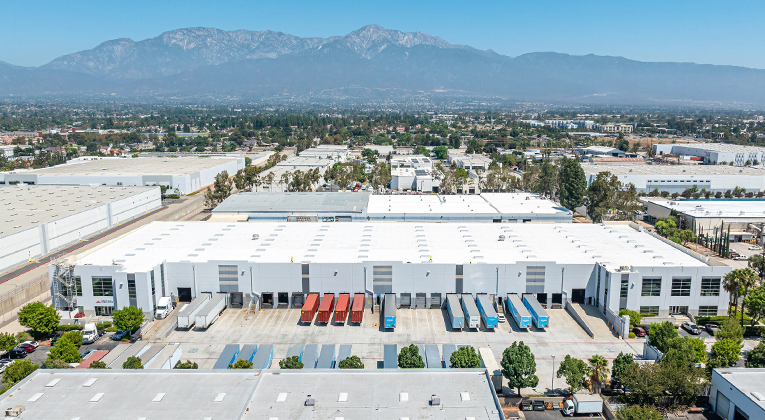
The twin ports of Los Angeles and Long Beach process approximately 40% of all container imports and 30% of all U.S. exports. The evolution of Inland Empire industrial demand hinges on access from the twin ports. Container ships carrying products and components from China and other parts of Asia come into Southern California and are then trucked to the Inland Empire, or to other U.S. markets by rail, to be broken down for distribution throughout the western United States and beyond. With the Los Angeles region running out of developable industrial land a few decades ago, and the need for new large state-of-the-art 30’-40’ clear-height warehouse buildings, the Inland Empire was the closest location to build new warehouse facilities.
How the IE Stacks Up to Other Major U.S. Markets
From 2023 to the present, consumer behavior has drifted toward pre-2020 norms, and the demand for industrial space has also reversed due to the slowing of imports coming into the United States. When compared to the nation, the Inland Empire has shifted from being one of the tightest industrial markets in the country, to now one of the top five softest at just over 14%. Overall, the national industrial markets are not healthy and have moved solidly into leaning toward being tenant-favorable, and only Los Angeles and San Francisco are still marginally below 10%, considered to be somewhat in landlord territory.

The Inland Empire Swing—the Biggest in the U.S.
The Inland Empire regional industrial market has become very tenant-favorable post-Covid, as supply and demand conditions for industrial space have shifted such that availability rates around the region have spiked in the last three years. Availability has more than doubled since pre-Covid from just under 7% to now just over 14%, and still rising. An even more troublesome benchmark is that the IE market availability today is four times higher than at the tightest market conditions in recent memory when IE availability was approximately 3.5% towards the end of 2021.

Oversupply Contributors
Much of this availability spike is based on speculative overdevelopment of industrial buildings built from 2020 to 2025 to support the surge of online consumer purchasing during the early years of Covid. Nationally, between 2020 and 2025, 1.2B SF of industrial space was built around the country, a historic supply increase of 13.11% over those five years, of which 111.9M SF was added to the Inland Empire inventory, the largest amount of new construction in any market in the United States.
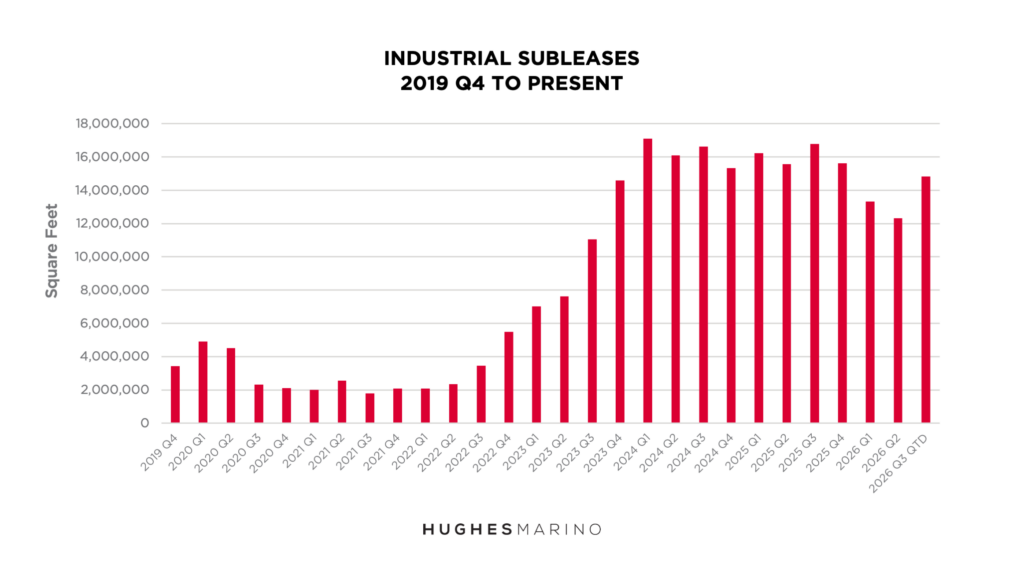
The second contributor to this oversupply is that the region has been haunted by a spike in industrial sublease inventory, averaging 14,000,000 SF for three years running. A national phenomenon, many industrial companies are looking to shed excess space they leased during the 2020-2022 run-up. The specific reduction of imports coming into Southern California, and an increase in warehouse options in the Los Angeles area, have caused many Inland Empire operators to lean down their footprints and put excess space on the market for sublease. There are values to be had throughout the region in all size ranges. This sublease condition is expected to last well into 2027 and 2028, and creates a condition where tenants have become landlords’ biggest competitors.
How the Submarkets Stack Up
The chart below shows how every IE submarket is at 10% or higher availability, with the Temecula/Menifee region having the biggest uptick at over 25%, one of the highest availability rates in the entire U.S. With the exception of Corona/Eastvale, every other submarket has doubled availability as compared to the start of 2020, with Temecula/Menifee tripling since and Chino/Chino Hills increasing by 5x—one of the highest proportional spikes in the entire country. Warehouse space for lease often has been on the market for a year or two. While landlords are reducing rents, and free rent of a month per year has become table stakes, even on renewals, building owners have entered into a knife fight over tenants as demand continues to be tepid, and many tenants that do enter the market are looking to downsize.
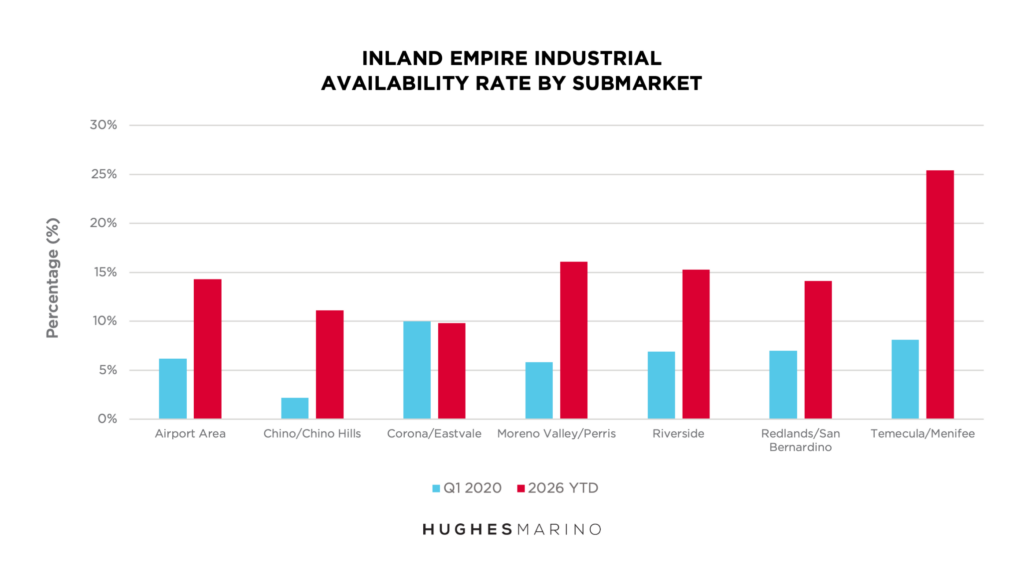
Overall, the Inland Empire and national industrial markets have done a massive pivot in the last year where many U.S. metro areas have higher availability, a reversal in rents and a spike in concessions. We are dealing with a new normal where tenants can expect to continue to find good values and numerous opportunities for several years to come, as long as they are proactive in addressing their lease expirations and aggressively go to market with the right tenant advisor who is free of landlord listing conflicts of interest, to create the proper leverage and optionality.
Market statistics provided by CoStar Group.