
Five and a half years post-Covid, and the trauma of remote and hybrid working on the national office market has become fully developed and realized. Across the country, record high inventories of office sublease space came on the market, and in many major U.S. cities, availability rates have increased by more than 50% above their pre-Covid amount. Many downtown urban centers around the country have hit over 25% available, with downtown San Diego having the highest availability rate in the country at 35%. The suburbs nationally have faired better, with suburban availability rates generally ranging from 15% to 25% in most metro areas, but still rattled as companies have shed space due to their decrease in office footprint requirements.
UTC Office Space Finds a New Normal
At the beginning of 2020, UTC had a low availability rate of approximately 8%, which increased at the peak of Covid to 22%, settling down over the last three years to the 16% to 19% range, still approximately double its pre-Covid rate. This is the new normal, far from being a landlords’ market, where rents have been stagnant for the last couple of years, not going up, but not going down any further as availability rates have settled into equilibrium.

No matter the size of space required, UTC tenants today have an extensive number of choices, with the following number of spaces available based on these square footage ranges: 2K-5K SF—43 options; 5K-10K—26 options; 10K-15K—12 options; 15K-20K—7 options; contiguous in a building over 20K—5 options. As we look to the future, availability rates should stay in this general range as there is not expected to be any significant organic growth of office tenants in UTC, nor migration to UTC from other submarkets. If anything, a number of large insurance and accounting firms have leases that expire in the next three years, and many of those are still carrying excess capacity from long-term leases that were signed pre-Covid. It’s likely that these tenants will get incrementally smaller over the next 2 to 3 years as their leases expire, keeping availability rates in UTC in tenant favorable range.
Over the last five years, suburban submarkets like UTC have fared much better than downtown central business districts in those same metro areas for a number of reasons. First, the nation’s suburban submarkets were generally stronger than their downtown counterparts to begin with. Second, employees’ big objection to coming into the office is not about the office itself, but rather the cost of commuting, both in time and money. Parking is substantially more expensive and limited in downtown areas, and the incremental commuting time from the suburbs to the nation’s downtown business districts is much more significant for most employees. Third, many downtown areas, like San Diego’s, have been hit by increased urban distress, whereby employees and employers have found that the suburban markets offer more security and cleanliness than their urban counterparts.
Time on the Market Doubles
The other statistic we use to judge the health of the office market is the time by which the average space has been on the market. Five and a half years ago, the average time a suite sat on the market was six months, and landlords could be comfortable that new tenants would be there to backfill vacancies. That amount of time has doubled to a year, whereby if a landlord loses a tenant that chooses not to renew, or the landlord isn’t competitive enough for a new one, that space could sit on the market for a long time.

The Demise of Eastgate
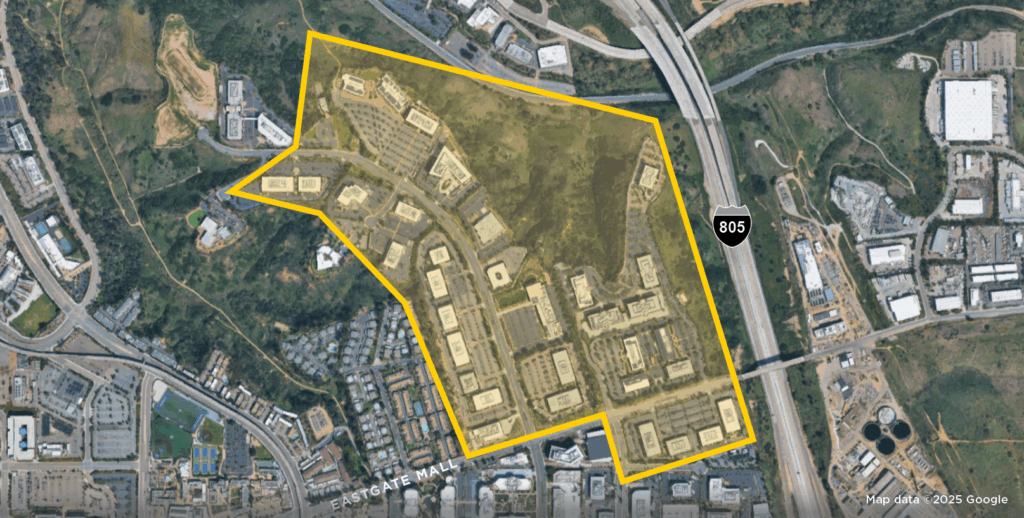
The statistics presented above do not include the Class B office space available in Eastgate Technology Park (Eastgate), which is the northeastern portion of UTC, north of Eastgate Mall along the Towne Centre Drive corridor as shown below. The biggest change in the UTC office market in the last two years is the spike in availability in Eastgate, primarily comprised of 2-story buildings with free surface parking, and almost exclusively owned by The Irvine Company. A third of the Eastgate buildings are leased by ServiceNow and Apple, whose expansion from 2020-2023 drove up prices in Eastgate to the point where there was essentially no space left to lease in 2023. With Apple no longer expanding in UTC, and ServiceNow recently downsizing and renewing, other local companies with leases expiring have either been priced out of this market or downsized in place, driving availability rates up to 19%. With this spike, The Irvine Company has decreased asking prices in Eastgate twice in the last year, reducing rent expectations by $0.80-$1.00 per square foot.
Residential Coming to the UTC Core
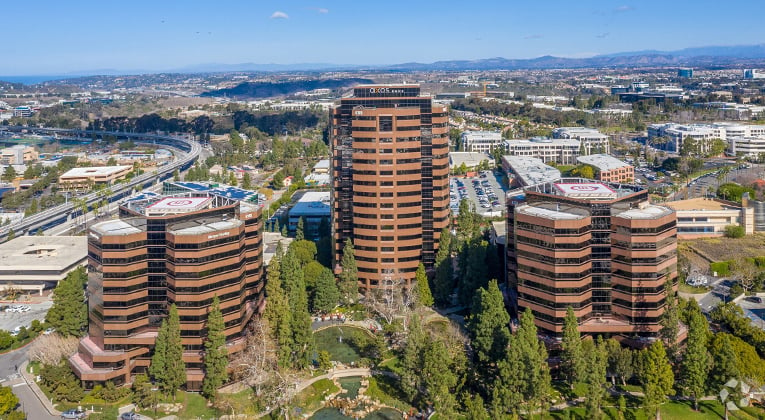
The big story in UTC is the amount of residential that will be coming online along the Genesee corridor. The Irvine Company has announced a new 552 unit apartment project that will be constructed at the northeast intersection of La Jolla Village Drive and Genesee, formally the buildings where California Bank & Trust and Specialties Restaurant were, as pictured below. These buildings have been emptied out and will be demolished next year to create a live-work environment in the heart of UTC. When this residential community is completed in a few years, The Plaza and Executive Square to the west across Genesee, will truly become some of the most desirable office addresses in the county.

Not far behind that, the former Costa Verde Mall site to the west of Genesee across from Nordstrom, is also scheduled for residential. Originally slated for redevelopment by Alexandria Realty to become a new world class office and life science headquarters project, the property is being repositioned for residential uses, which will additionally support the melding of office, retail and residential. This combining of mixed uses is essential in our urban communities to provide housing where the office jobs are and help to reduce the amount of commuting traffic congestion, and the environmental impact thereof.
Looking forward two or three years, UTC will become the preeminent live-work-play hubs of the Southern California region, and it’s a great time to lock in your long term pricing now before the market likely begins to tighten up in 3-4 years.
Market statistics provided by CoStar Group.