
How We Got Here
If you are a business owner or executive team member operating a San Diego County industrial distribution or manufacturing company, you’re probably still reeling from the run-up of industrial rents from 2020 through 2023. The outbreak of Covid in the second quarter of 2020 created a run on industrial real estate by the fall of 2020. By 2022, availability rates had gone down to historic lows where tenants were competing over space, whereby rental rates increased 50% to 75% depending which submarket you’re in.
Commercial Availability Explodes
In response to this historic demand surge, developers began construction on new industrial space throughout the region, where approximately 11,400,000 square feet of new construction was added to the County’s industrial base from 2021 to present. Much of that was in the South Bay where 9,500,000 square feet was added, representing 83% of the region’s new construction. Just as those developers began flooding the market with new construction in 2023, San Diego tenants began to see a cooling off of consumer online purchasing, and availability rates clipped up just as all of the new construction began to deliver. Digging into major submarket detail, the bar chart below represents each submarket’s pre-Covid availability rate relative to today.

To put the above graph in context, with the exception of Carlsbad, the rest of North County is currently 30%-40% above their pre-Covid availability rates, and heading into tenant-favorable territory at 12%-14%. Nonetheless, given the ongoing tightness in Kearny Mesa, the I-15 and East County, much of the region is materially worse off than their pre-Covid condition. With Sorrento availability at 75% higher and Miramar at an 118% increase, both markets are now in equilibrium where prices are neither rising nor falling materially, at 10%-12% availability. The worst casualty in the region is in the South Bay/Otay Mesa markets, which are 124% higher than their pre-Covid rates. The South Bay/Otay Mesa markets are strongly in tenant territory at 17.5% availability, and the landlords there are making deals, with rents in Otay dropping to the $1.05-$1.20 NNN range—the cheapest warehouse space in the County. The bottom line is that rent inflation is now a thing of the past, and it’s going to be an ongoing battle in the market between landlords and tenants to determine future prices.
Manipulations by the Brokerage Community
You’re probably asking, “How come I didn’t know this until now?” Commercial real estate landlord brokers distort the measure of the market by using “vacancy rates” instead of “availability rates.” If you’re looking through the tenants’ lens, which we have done for over three decades, you need to include all space for lease or sublease that a tenant has to consider, including buildings under construction, occupied subleases and space for lease that’s not yet vacant—all categories of available space that the landlord brokerage industry conveniently excludes from “vacancy.” This is just one of many ways that the big landlord brokerage firms steer the market in favor of landlords to the detriment of tenants, where tenants are led to believe that the market is tighter than it is, and overpay for their commercial real estate leases.
Sublease Inventory Explodes to New Levels
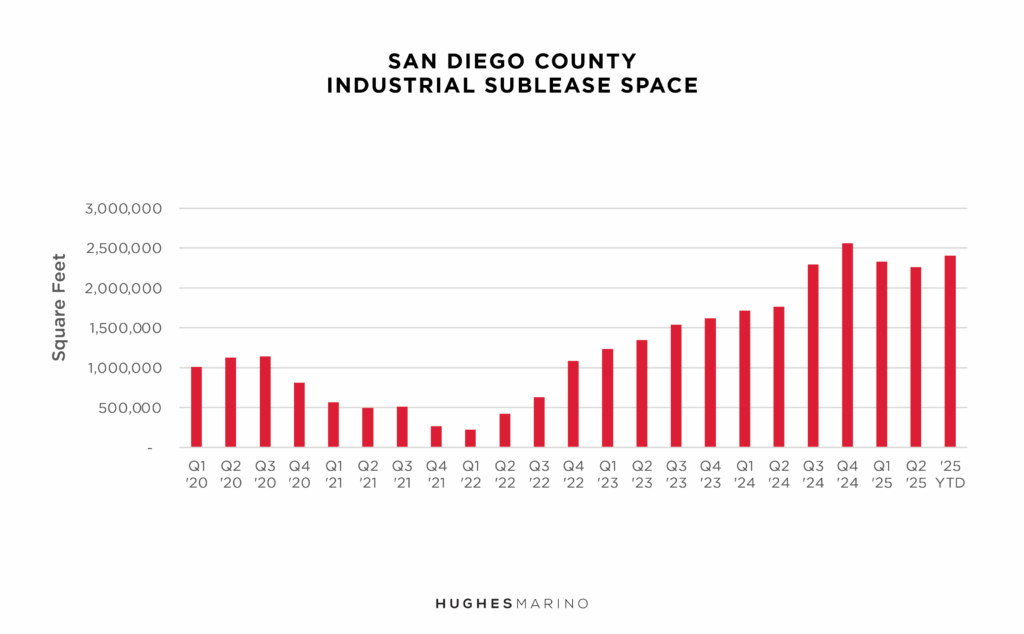
What also has been hidden from business owners is the extent to which sublease inventory is dragging the market down. While sublease inventory in San Diego County was relatively tight at 1,000,000 square feet before Covid, as e-commerce companies and 3PLs began a feeding frenzy for space at the end of 2020 through early 2022, sublease inventory virtually evaporated from the market with a low of 250,000 square feet. However, as the same industries began rationalizing their portfolios and leased space over-commitments in 2023, sublease inventory began spiking well beyond the pre-Covid rate, hitting a historic high of 2,500,000 square feet at the end of 2024…and is essentially stuck in that range. The chart below shows this rapid decline, followed by the rapid ascent.
Tenants Have More Options Than in Years Past
To put some real numbers around this, a tenant needing 10,000-25,000 square feet of industrial space has 166 options in San Diego County today (37 are subleases). A tenant needing 25,000-50,000 square feet of industrial space has 99 options (22 are subleases). A tenant needing 50,000-100,000 square feet has 62 options (11 are subleases). A tenant needing 100,000+ square feet has 23 options (3 are subleases). In the Central County area however, there are lingering supply shortages for spaces larger than 10,000 square feet. Notwithstanding, there is a general shift to a tenant’s market, where tenants of any size have more building options for lease and sublease than they have had in many years, particularly if they are open to moving north or south from the Central County area.
Yet Landlords and Their Brokers Still Push High Prices
You’re probably wondering why prices haven’t come crashing down given all of this resetting of the market. Shouldn’t rents be back down to their pre-Covid levels in these softer submarkets, or less? While we’re seeing slight decreases in asking rents, the landlord brokerage firms have found another way to position the market against the commercial real estate tenant. With the brokerage community working as landlords’ proxies, and too frequently acting as conflicted dual agents representing both the landlord and the tenant in the same transaction, landlords have full transparency as to what each other is doing in real time, and often what buildings a tenant is looking at. Tenants’ confidential information rarely stays that way for very long, and landlords know who’s doing deals, and at what terms, while tenants are lured into thinking prices are the same as they were back in 2023.
What Business Owners and Executive Teams Need to Do Now
Any serious negotiation requires accurate information, leverage and the right mindset. Trying to represent yourself in this dynamic market with the flood of options is a fool’s errand. Tenants need to engage a tenant representation company as their business partner, and as their advocate whose interests are aligned with theirs when considering expansion, relocation, lease renewal/restructuring or purchasing. Ultimately, the “customer” in a relationship is the party that pays for a good or service. The tenant writing a rent check is the customer in the landlord/tenant relationship, but tenants have never been treated where “the customer is king.” It’s time for tenants to take their power back by fully vetting and understanding the realities and extraordinary opportunities that today’s market presents for them.
Market statistics provided by CoStar Group.