

By David Marino
If you are a commercial real estate tenant in Del Mar Heights today, you likely noticed that landlords’ asking rents have spiked. There is only one project on the market with an asking rent below $4.50 plus electricity (12555 High Bluff at $4.25), and most range from $4.95–$6.15 per square foot. Surely this would mean that Del Mar Heights is in high demand, as these record-high asking rents must mean that availability rates are tight and that space is hard to find…but that could not be further from reality.
The Truth Landlords and Their Listing Brokers Don’t Want Tenants to Know
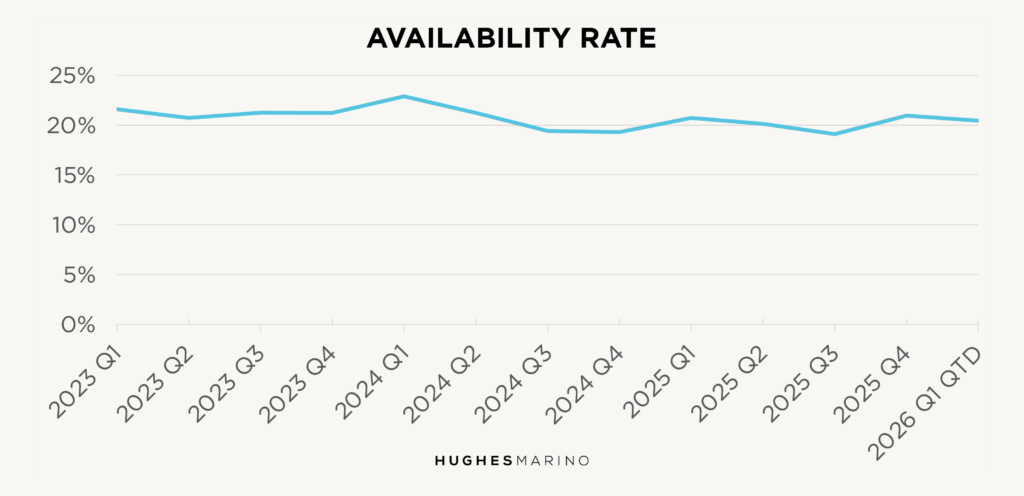
The fact is that office space availability has trended from 19%-22% for the last three years, one of the higher availability rates in San Diego County, higher than Mission Valley, Sorrento Mesa, UTC and the I-15 corridor.
Further, the average time on the market for office space in Del Mar Heights is the highest in four years at 16 months. Many office suites have been on the market longer than two years.
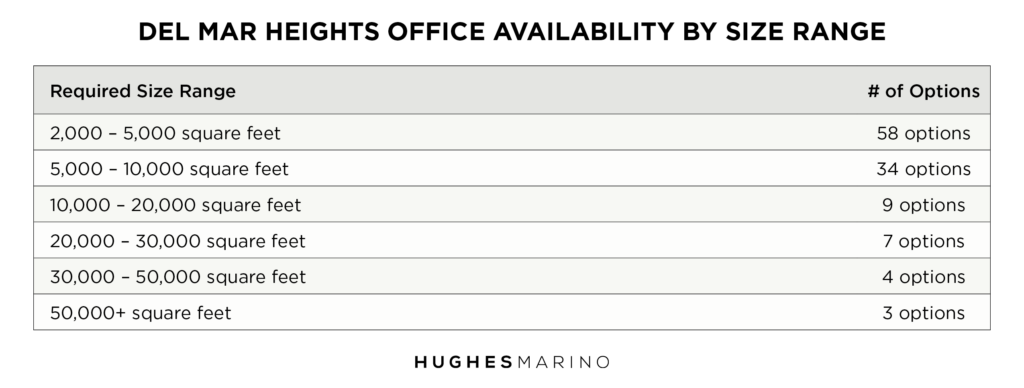
Depending on what size of space you are looking for, options abound in Del Mar Heights today. Here are the number of options that tenants have depending on their required size range:
From an economic fundamentals standpoint, the Del Mar Heights market is frozen in place, arguably getting worse when time on the market is considered… yet prices in the last year are up 15%–20%. So what is going on with the pricing surge, while conventional supply and demand dynamics do not support it?
Three Factors Driving Price Increases in Del Mar Heights Today
Cause #1: Landlords are Anchoring off One Paseo
The first factor is Kilroy Realty’s 100% leased One Paseo mixed-use project, the most expensive office space in San Diego County pricing from $6.50–$7.00 when a space comes on the market, typically triggering a bidding war. Given the once-a-year lease or sublease that has occurred in this project in the last few years, other Del Mar Heights landlords have felt emboldened to push their asking rents up, even though their offerings do not compare to One Paseo’s location, amenities, quality and unique desirability. The competition is offering the same old spruced-up office buildings constructed 20–40 years ago, testing what tenants are willing to pay to be in Del Mar Heights.
Cause #2: Abnormal Ownership Concentration
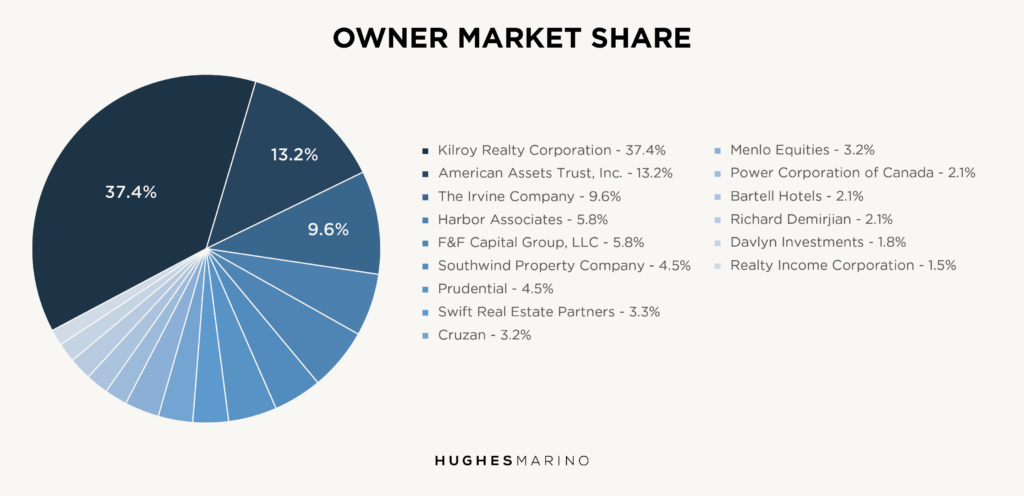
The second powerful force driving asking rents is that office property ownership is concentrated among very few landlords, allowing building owners to move in lockstep to follow each other on the way up. As shown on the chart below by square footage, which removes all of the medical office and biotech wet lab buildings from the statistics, Kilroy Realty owns 37% of the office market, with American Assets owning 13% and the Irvine Company owning 10%. As a force, these three landlords own 60% of the Del Mar Heights market, which is a highly exceptional ownership concentration for any office market in the United States. In other regulated commodity markets, competitors working cooperatively to move prices could be considered price fixing, but this action isn’t formal collusion. Rather, these landlords all have full information from the big landlord brokerage firms that share what each landlord is doing with the other building owners, and then each follows suit accordingly.
Cause #3: Abnormal Landlord Listing Broker Concentration
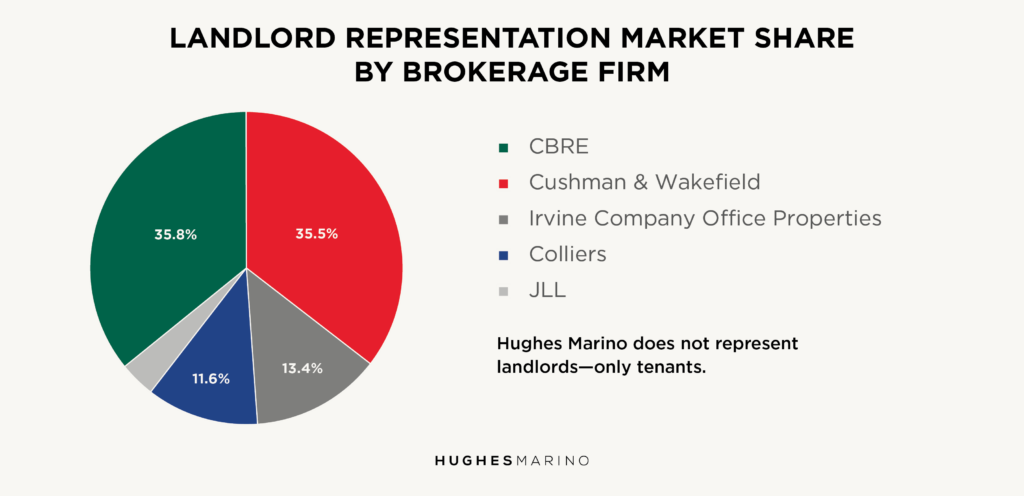
The third, and potentially the most powerful force contributing to the rise in asking rents, is the concentration of landlord listing agents that are hired by building owners to promote building owners’ interests to get and keep their buildings leased, and help them obtain maximum value of their assets through the promise of rising rents. As shown on the chart below by square footage, which removes all of the medical office and biotech wet lab buildings from the statistics, CBRE and Cushman & Wakefield each represent 36% of the landlord listing market for 72% combined. While the Irvine Company does its own leasing with in-house brokers, Colliers has another 12% of the market. As a force, these three landlord proxy listing firms of CBRE, Cushman & Wakefield and Colliers dominate the landlord advocacy market with 84% of all of the listings. There are very few situations like this in the country, and not a one in San Diego County, where so few landlord service firms control so much of the office space inventory. In any other commodity market, a federal government antitrust division overseeing such activities might accuse the commercial brokerage industry of price supporting. But there is no regulatory agency overseeing the landlord brokerage industry, where brokers share comps and other confidential information about tenants’ leases with other competitive building owners and fellow brokers, who then are empowered to move markets whether real supply and demand dynamics warrant it or not.
The entire market is rigged against the tenant, as tenants don’t understand the market and their options very well, particularly at renewal time. With inflated asking rents, tenants don’t fully understand what a good deal looks like. As each uninformed and innocent Del Mar Heights tenant signs a lease at a new incremental high, and that comparable (“comp”) is shared with landlords and the brokerage community that supports them, the notion of rising rents becomes a self-fulfilling prophecy.
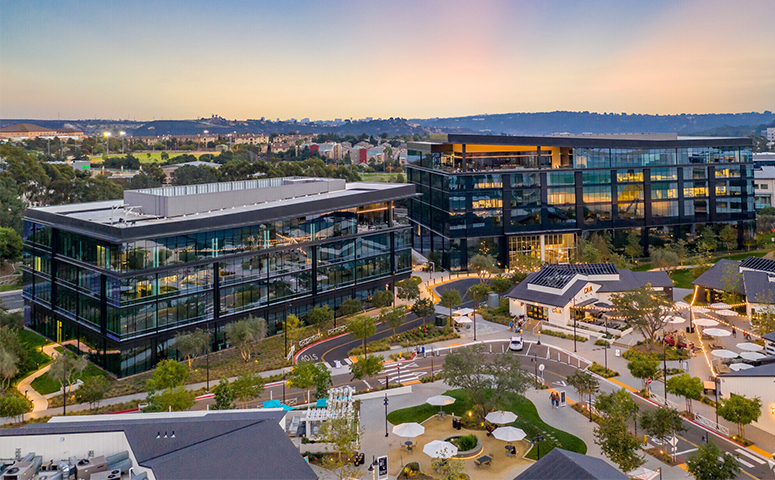
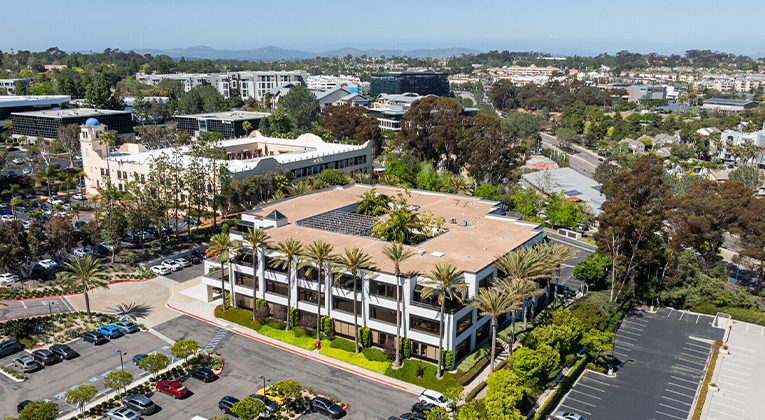
One Paseo, Kilroy Realty’s fully leased Del Mar Heights building, commanding $6.50-$7.00/SF and setting the pricing benchmark for the entire Del Mar Heights market.
How Commercial Tenants Can Take Back Their Power
The problem for Del Mar Heights office tenants, and commercial tenants across the entire country, is that tenants are not collectively organized or supported, and have to conduct business with information asymmetry against landlords and their proxy listing brokers. The only way to deal with such inherent landlord and brokerage community manipulations is to understand what is happening, and not to think that you can somehow negotiate your way through or around it—the forces working against you are too powerful. The solution is to engage a tenant representation firm that sees the truth in today’s market realities, and not what landlords and their brokers would like you to think truth is. Tenants need alignment with their interests and their agency representation, and to stop working directly with landlords or any broker or brokerage firm that represents landlords, and bring these inherent dual agency conflicts of interest into the light of day where they belong.
Market statistics provided by CoStar Group.