
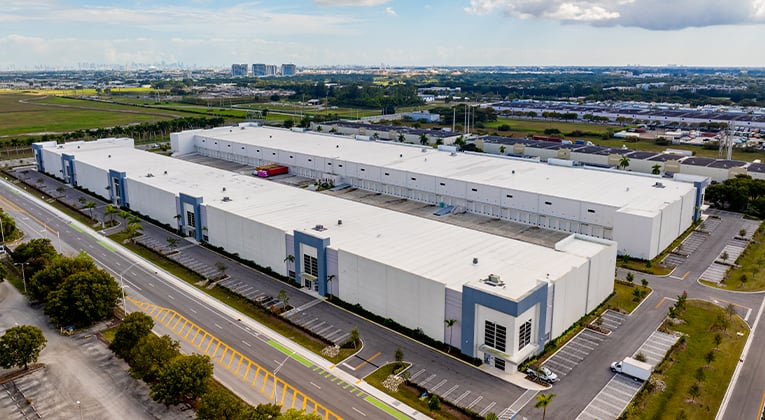
While all of the news regarding Covid’s negative effects on commercial real estate focused on the office market in the early years of the pandemic, it’s now the industrial market that has stepped into the spotlight. Covid’s industrial demand spike from 2020 through 2022 induced real estate developers to bring on 1.2B SF of new buildings over the last five years to accommodate growth that ultimately fully reversed by 2024.
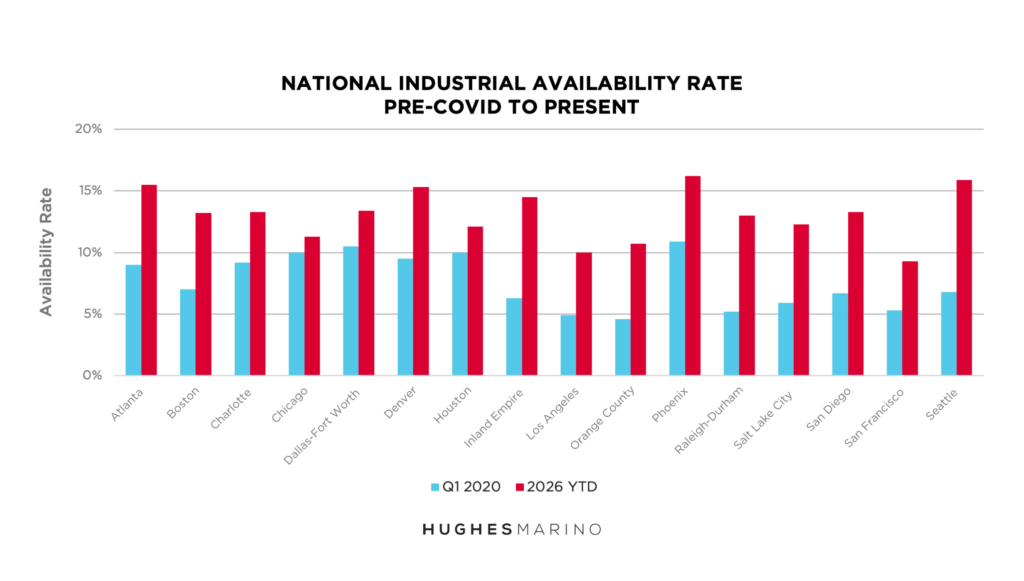
The national industrial markets began showing distress in 2023, which has since become a significant downturn. As shown by the chart below comparing the first quarter of 2020 to current conditions, availability in nearly every major U.S. metro industrial market is now significantly higher than pre-Covid levels, and in many cases availability rates have doubled over that time.
To bring this to life, there are a historically high number of buildings on the market for tenants to choose from, no matter what size range a business owner might be looking for. For example, the number of large buildings over 100K SF available today is 244 in Atlanta, 281 in Chicago, 333 in Dallas-Fort Worth and 243 in the Inland Empire. The market is flooded with options for tenants, and the overbuilding of the industrial sector has never been more severe.
What is so frustrating for industrial tenants is that landlords’ asking rents today are still universally higher than they were back in 2020. While there’s no economic supply-and-demand theory that would ever support higher prices given the spike in availability, landlords and their brokerage firms have worked hard to hold the line on pricing and keep asking rents artificially high. Despite a significant uptick in free rent and tenant improvement allowances, rental rates are finally starting to break as many landlords have had their buildings vacant for two or three years now. With the exception of large institutional investors, landlords need to either meet the true market or meet their lender. Landlords in markets like Atlanta, Denver, the Inland Empire, Phoenix and Seattle are particularly at risk with availability rates climbing into the mid-teens and expected to rise further in 2027.
The biggest story continues to be the glut of sublease space nationally, with 238M SF still on the market. While down from the peak of 272M SF just a year ago, this volume of sublease inventory will continue to drag down markets as industrial companies find themselves with excess space caused by a decline in imports and reduced cross-border economic activity.

From touring hundreds of industrial facilities throughout the country annually, we estimate there are several hundred million more square feet of “shadow inventory,” space where tenants do not fully occupy the buildings they lease but cannot physically or securely demise excess space that they would otherwise shed. As a result, many companies will likely downsize in the next two to three years as the next wave of leases expires, pushing availability rates higher around the country.
Today’s sublease inventory is concentrated in certain markets, as shown by the chart below. The largest share sits in the Southern California industrial markets of the Inland Empire and Los Angeles, where a combined 25.7M SF has rocked the region, making up approximately 11% of all sublease inventory nationally.
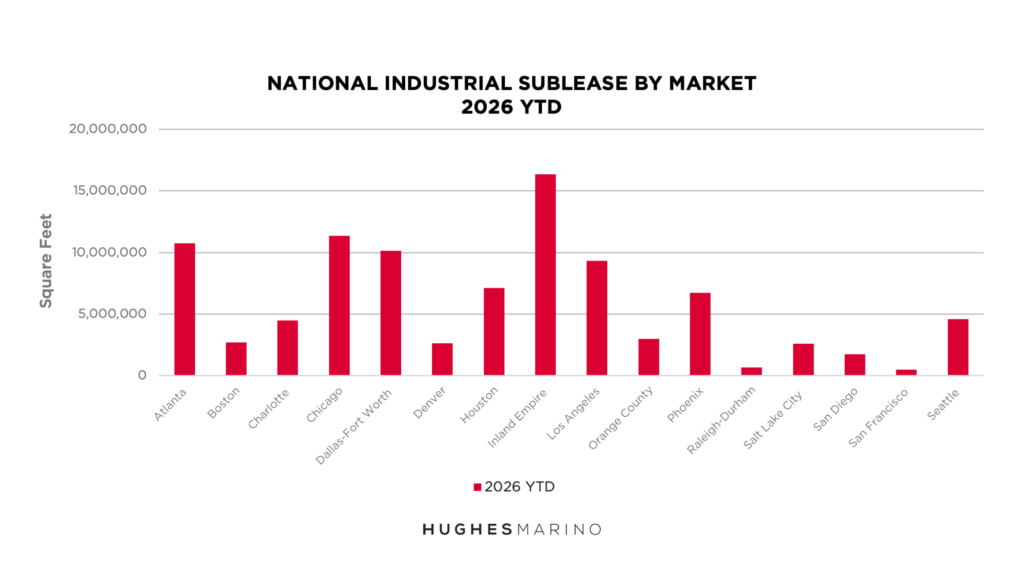
Atlanta, Chicago and Dallas-Fort Worth all hover between 10M and 12M SF each, creating opportunities for tenants in those markets as well. Houston and Phoenix line up next between 6.5M and 7M SF each, where companies can take advantage of sublease space that is often fully racked and priced well below market.
The U.S. industrial markets continue to worsen slowly quarter by quarter and will be searching for a bottom in the next two years. Barring an economic shock that could make conditions worse, we can expect tenants to be able to get good values for some time, but landlords and their backstopping brokers aren’t just giving them out. Prudent tenants and business owners need to go to market to create leverage and optionality when it comes to their lease expirations and start the process at least a year in advance so they aren’t held captive in an over-market renewal.
Market statistics provided by CoStar Group.