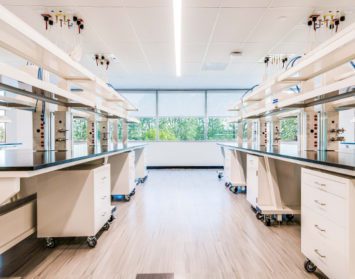
When the COVID-19 pandemic hit, life science companies began attracting serious investment, hiring as fast as they could find talent, rushing to secure space to develop new drugs and vaccines and to manufacture medical equipment and supplies. Real estate investors, panicked over the rush to remote work and shuttering office space, quickly found an attractive new sector to deploy their capital in the life science market. Developers began snatching up available industrial space to build custom GMP-ready facilities at premium cost for these growing companies.
Across Boston, San Francisco, San Diego and Seattle, the life science start-up sector took off following the pandemic—pulling in 70% of all venture capital invested in 2021-2022.
Leading the way is Alexandria Real Estate Equities, which has 74.6 million square feet of lab space across San Francisco, San Diego, Seattle, Boston, New York City, Maryland and Raleigh Durham’s Research Triangle Park, along with existing life science-focused REITs like New York-based BioMed Realty and Healthpeak Properties. Many new players have ventured into the life science development arena including Longfellow Real Estate Partners, Sterling Bay, Oxford Properties and Lincoln Property Company, to name a few, which has created a buying frenzy.
Private Companies’ Vacant GMP-Ready Facilities
Seemingly as quickly as the demand for lab space shot up, just a few years later the pandemic has ended, biotech stocks have taken a sharp downturn and capital has dried up. Private companies are now struggling to raise their next financing round with inflated valuations and those giant GMP-ready facilities are sitting vacant. A few examples:
- Puritan Medical Supplies in Guilford, Maine, received $75.5 million in 2020 to build out a new 95,000 square foot facility to double its production of nasal swabs—producing 20 million a month at its peak. Now, with demand for COVID-19 tests down, Puritan closed its Tennessee facility and laid off 272 workers.
- Drug manufacturer Resilience launched in 2020 and established a network of biopharma manufacturing sites across the U.S. and Canada to boost production of cell and gene therapies, vaccines and proteins. The company bought a former Genzyme 310,000 square foot manufacturing plant in Boston from Sanofi in 2021, keeping on some 250 staff. Initially, Resilience continued to make biologics for Sanofi at the site but ultimately set their sights higher, upgrading the site to meet modern GMP requirements. Now, the contract with Sanofi has ended, and Resilience is laying off employees at the site and ultimately could not capture the commercial interest they had hoped for.
- Thermo Fisher Scientific shut down three San Diego facilities totaling over 200,000 square feet and laid off 230 workers—the third reduction in the local workforce this year—citing a decline in demand for COVID-19 tests and changes in the economic landscape.
- Boston-based Longfellow Real Estate Partners was planning a 750,000 square foot life science center in Emeryville, CA, buoyed by the momentum of the pandemic-fueled life science growth. Recently the Swiss biotech Lonza Group AG which was in negotiations to lease 150,000 square feet has pulled out, causing Longfellow to dramatically scale back the development.
A National Trend
Across the country, the same story is unfolding. The demand for massive GMP-ready life science buildings—those with existing high power, ample ceiling height, lab and manufacturing improvements, chillers, boilers, shipping and receiving—has vanished, with the pandemic-fueled demand waning and many biotechs consolidating, downsizing or shuttering following a cooling of capital markets.
That’s leaving a glut of buildings on the market that are now too expensive for the non-life science manufacturing companies, which before the massive investment into GMP improvements was made, could have used those buildings to design and deliver goods with the rise of e-commerce, a trend which shows no signs of abating. In San Diego, vacancy rates of GMP properties are up to 4.9% from 2.8% a year ago, or 55% increase. In Boston, they are at 5%, 25% higher than the previous year, and up to 7.7% in San Francisco, from 5.8% a year ago, equaling a 28% increase.
As Demand Slows, What Happens Next?
With the cooling of the capital markets, persistent supply chain issues and the immense amount of capital investment required from the tenant for construction, (often in excess of $1,000 per square foot), it’s unlikely that we’ll see a resurgence in demand for these custom, GMP-ready spaces for the foreseeable future.
Modularity
One trend that remains strong however is the shift toward modular facilities—mixed use office and lab spaces that can produce multiple products under one roof—from monoclonal antibodies to cell therapies to mRNA vaccines. This is the vision behind Merck’s FLEx (Formulation Laboratory, Experimental) in Rahway, NJ, which is designed to be repurposed, used for human health and animal health, and features portable equipment and prefab adjustable clean rooms. The idea is that the building can evolve along with a company’s needs.
Another example of such modularity is located in Philadelphia, where general contractor TN Ward has just completed renovation of Race Street Labs, a 180,000 square foot life science facility adjacent to Drexel University School of Medicine that included renovating the existing building and constructing two floors of customizable lab and office spaces. The site’s website boasts move-in ready lab suites with on-site office management and lab support services.
To meet the changing needs of new biotechs, including those who are applying emerging artificial intelligence and robotics technologies to drug discovery and manufacturing, buildings will need to be customizable and easy to adapt to change.
As Anthony Giuliano, general manager of life science construction at Lendlease, told ConstructionDive: “Over the past few years, pharmaceutical companies and other users of life science space have increasingly sought out facilities that provide flexible operations, and I absolutely expect this trend to continue. The upsurge in companies exploring mRNA therapies following the success of the COVID-19 vaccines illustrates why [product] diversification and the ability to be nimble is so important.”
Quality of Life
Beyond flexibility, companies are looking for quality of life—properties like Princeton West in New Jersey, an R&D campus with a robust infrastructure, modern lab and manufacturing space, café, fitness center and walking trails. Already the site is home to a number of global companies like BeiGene, PTC Therapeutics and Passage Bio, and it continues to expand—announcing plans for three new manufacturing buildings totaling 380,000 square feet.
Prices have to shift to reflect changing demand. San Francisco has been particularly hard hit with the push toward remote work and wave of tech layoffs—with office vacancy tripling since before the pandemic. Landlords in the Bay Area are responding by lowering rents to lock in longer term leases with biotech tenants as the downturn intensifies. Precision oncology firm Ideaya Biosciences achieved a rent drop of nearly 35% on its lease for a custom-designed lab space at DivcoWest’s 5000 Shoreline Court in South San Francisco’s life science cluster.
The Upside for Life Science Tenants
So, what do these shifts mean for biopharma and biotech companies looking for manufacturing space or lab space in near proximity to top research universities? Tenants should be seeking opportunities to limit upfront capital investment and extend their funding runway—subleases are a great opportunity to take advantage of expensive in-place manufacturing infrastructure to reduce capital investment required—or they should seek out motivated landlords willing to offer unprecedented concessions such as turnkey tenant improvement allowances to fully cover the construction costs along with providing significant free rent packages.
Ultimately, there has never been a better time to find flexible GMP and lab space in the country’s top bioscience hubs.
About HM Science
HM Science is a specialized life science division within Hughes Marino, a global corporate real estate advisory firm. Our team provides life science companies with bespoke corporate real estate services, specializing in the unique needs and critical specifications of the industry. With three decades of experience, we are proud to be one of the nation’s most experienced life science tenant representation firms. The team at HM Science specializes in serving the most intricate needs of sophisticated biotech, medical device and other health care companies with the technical expertise and end-to-end service integration to deliver first-class results. No matter the size or location, our team understands the specific technicalities and has the local market knowledge and vast experience to ensure our clients secure the highest caliber and most operationally strategic facility for their needs.
Visit www.hmscience.com or contact our HM Science team directly at contact@hmscience.com or 1-844-662-6635 to learn more.