
The Details: A Submarket-by-Submarket View
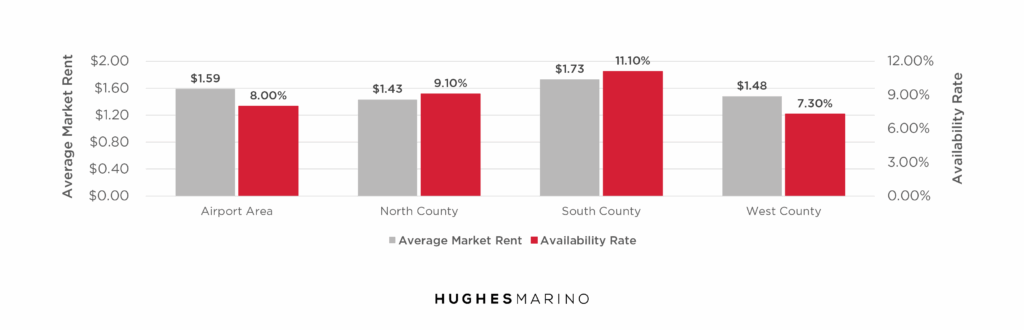
Looking at an overall market report can be helpful, but without context, it can be misleading. Each submarket, city, neighborhood and even building is uniquely positioned within the greater market. In this section, we aim to shine light on the nuances of the four primary regions of Orange County. As you can see, rental rates tend to be higher as you move south, and lower towards the north end of Orange County. What is consistent is that availability across all submarkets is increasing at a steady pace, and pricing has started to adjust accordingly.
The Big Picture: What’s Driving Orange County Industrial Softening
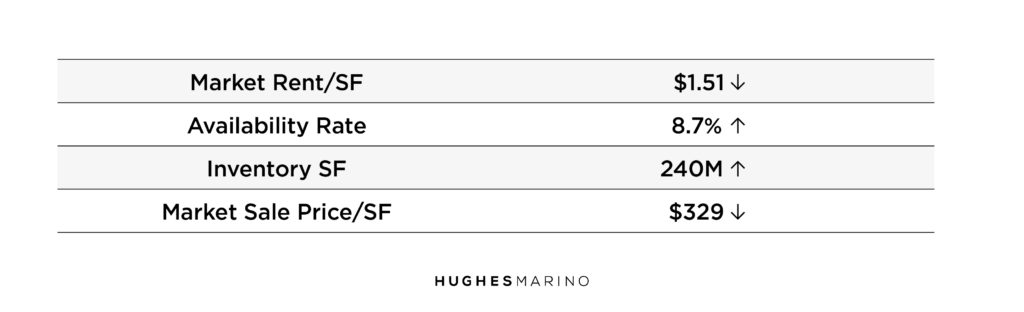
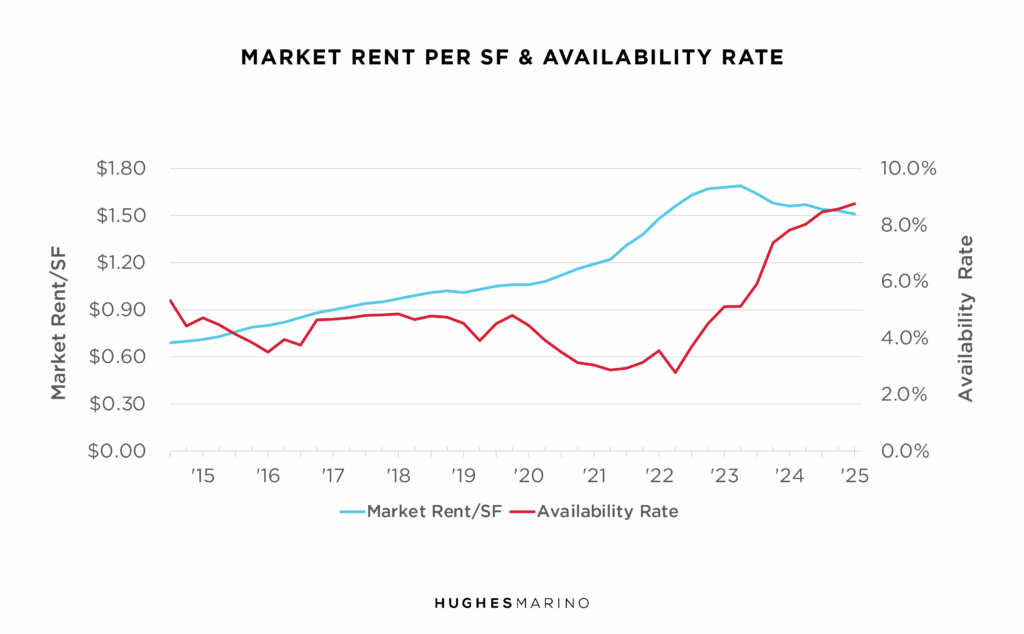
The below table offers a snapshot of market average figures for the whole of Orange County. The market has been on a steady decline since its height in 2023, and tenants are finally in a position to take advantage of the situation. The three primary factors driving this softening market are (i) an oversupply of new development, (ii) a spike in sublease inventory and (iii) weakened demand due to macro-economic factors. While this trend mirrors what is happening on a national level, the market correction we have seen in Southern California has been more pronounced than nearly any other region in the country. Tenants are now downsizing their operations en masse and the result is the highest level of sublease inventory we’ve seen in decades. In Orange County, 17% of all available space is sublease space. These subleases are one of the primary factors driving pricing down and availability up. This is the softening of the market in action.
The Buzz: Inland Empire Losses & Tariff Impacts on the Ports
Inland Empire Leads the Pack in Losses
The neighboring Inland Empire was a bastion of industrial demand during the pandemic, but in its aftermath, we’ve seen the region suffer from a severe market correction. Q2 2025 saw over 4M square feet of occupancy loss in the region and a 15-year high vacancy rate of 8%.
Tariffs and the Ports
Tariff negotiations drove a sharp decline in imports from China this quarter, resulting in a 30% year-over-year drop in volume in May 2025. Should the federal administration secure the trade deals as planned, it may result in a similar spike in demand, which would be a harbinger for industrial real estate demand returning.
The Trend: Why Availability, Not Vacancy, Tells the Real Story
The true health of any market should be judged not by its vacancy rate, but its availability rate instead. In other words, we should worry less about what is currently physically vacant, and more about what is coming to market in the near future. For years, the trendline for availability was down and to the right as the market continued to tighten, but we have now watched the full cycle turn to the benefit of tenants. Unfortunately, these figures are not capable of truly illustrating how favorable today’s market is for tenants. They do not include the incredibly large concession packages most landlords are providing today, which include low annual increases on rent, large tenant improvement allowances and up to a year in free rent.
The Neighbors: Out-of-State Industrial Markets Gaining Availability
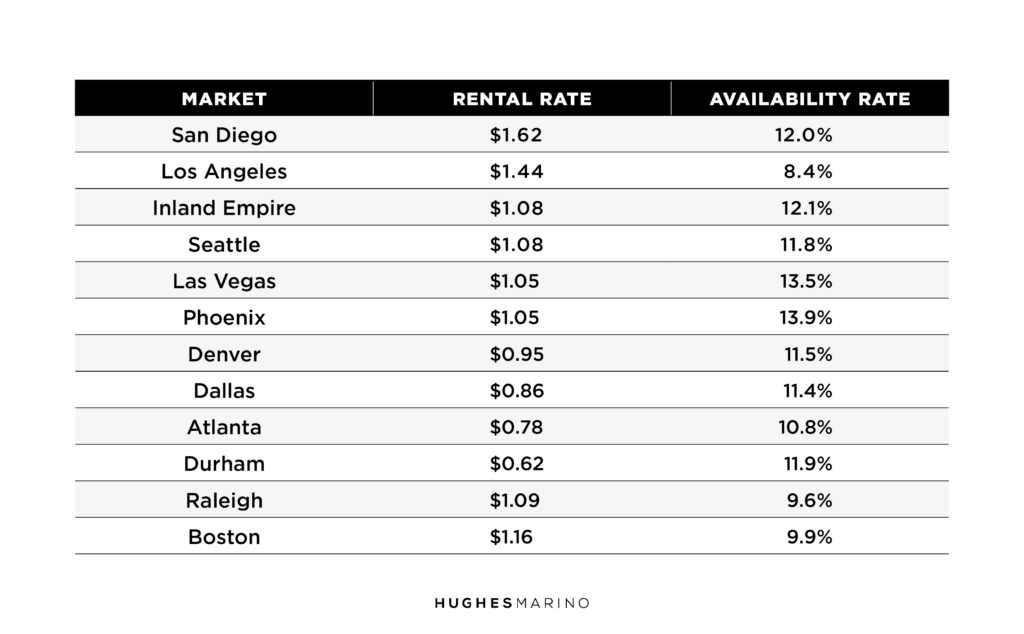
Southern California boasts some of the highest rental rates in the country. As a result, many companies that do not have an operational need to maintain a facility in the region have elected to relocate or expand out of state. Many major markets like Dallas, TX or Raleigh, NC can offer state-of-the art properties at less than half the cost of Southern California. These real estate savings often outweigh any costs of relocating, but must also be measured against operational costs such as drayage, labor, taxes, etc. Below is a snapshot of average real estate pricing across the country.
Frequently Asked Questions: Orange County Industrial Market Summer 2025
Yes. Availability has been climbing across every Orange County industrial submarket since the 2023 peak, sublease space now represents roughly 17% of all available inventory, and landlord concession packages have returned to levels we haven’t seen in years. For tenants with lease decisions in the next 12–24 months, now is one of the more favorable negotiating windows of the cycle.
Roughly 17% of all available Orange County industrial space is currently sublease. That is a decades-high level, driven by tenants who over-committed during the 2020–2022 run-up now rationalizing portfolios. Subleases typically price below direct asking rents, for shorter terms and are often offered plug-and-play, which puts meaningful downward pressure on pricing across the broader market.
Three factors: (1) an oversupply of speculative new development delivered between 2022 and 2024, (2) a sharp spike in sublease inventory as tenants rationalize over-committed space, and (3) weakened demand driven by macro-economic pressure, tariff uncertainty, slower consumer spending and reduced import volumes at the Ports of Los Angeles and Long Beach.
Tariff negotiations drove a 30% year-over-year decline in imports from China in May 2025. The Ports of Los Angeles and Long Beach are the demand engine for Southern California industrial, and throughput declines flow directly into warehouse demand. If trade deals are secured, demand could snap back, making import volumes one of the clearest leading indicators for the industrial market.
Landlords are offering some of the most aggressive concession packages we’ve seen in years: low annual rent escalations, meaningful tenant improvement allowances and up to a full year of free rent on longer-term deals. Published asking rates don’t capture this, which is why net effective rent, not face rent, is the only number that matters to a well-represented tenant.
Vacancy counts only buildings that are physically empty. Availability counts every building a tenant can actually lease today: direct vacant space, occupied space being marketed, subleases and buildings under construction. Availability is the honest measure of tenant choice, and it’s consistently higher than vacancy because it reflects what is really coming to market.
For many operations, yes, on a pure real estate basis. Major out-of-state markets like Dallas, TX and Raleigh, NC can offer state-of-the-art industrial product at less than half the all-in cost of Southern California. But real estate savings must be weighed against drayage, labor, taxes and proximity to the Ports. For port-dependent operations, staying in SoCal is almost always the right call.
If your lease is expiring in the next 12–24 months, or if you signed during the 2021–2022 peak and want to explore a restructure, this is one of the more favorable negotiating windows of the past decade. The combination of elevated sublease supply, new direct availability and aggressive landlord concessions means a well-run competitive process can capture material savings.
Engage a firm that specializes in representing tenants, one without landlord relationships to protect. Hughes Marino represents commercial real estate tenants only, across Orange County industrial submarkets from Irvine and the Airport Area to Anaheim, Santa Ana and North OC.
Market statistics provided by CoStar Group.