
By Owen Rice, Riley Hillis & Austin Lashley
From 2020-2022, the biotech industry was the standout of the U.S. capital markets, thanks to the vital role the industry played in the Covid-19 pandemic response and the unprecedented capital investment that flowed into the industry for the diagnosis and treatment of all disease conditions. With that fresh capital, biotech companies leased millions of square feet of biotech wet lab space from 2020-2022 in an unprecedented surge that real estate developers and their landlord brokers thought would last for many years to come. In contrast, back in 2023, Hughes Marino began sounding the alarms that a perfect storm was on the horizon for the Seattle region’s biotech wet lab market, that would affect all U.S. wet lab markets. That perfect storm would be comprised of 1) changes in the capital markets that would negatively affect demand, 2) growing wet lab sublease inventory that would unexpectedly increase supply and limit landlords’ pricing power, and 3) record levels of excessive new wet lab construction and office-to-lab conversions that would exacerbate the supply problem. We forecasted that these factors would collectively lead to a historic wet lab supply and demand imbalance, which is exactly what has occurred.
The South Lake Union Story
Since the 1980s, with its proximity to Seattle’s prominent research institutes and the University of Washington, South Lake Union had been the most desirable biotech submarket in the region. With historically very little availability and high prices, biotech companies began to lease and own facilities elsewhere, initially moving into Bothell in the 2000s, with a sprinkling of other companies pioneering areas of Woodinville, Redmond and Everett late 2010s and into the 2020s.
Over the last 30 years, South Lake Union has lost a bit of its caché as the quality of real estate in the surrounding submarkets elevated, and the price premium that tenants were willing to pay for South Lake Union reduced. Back in 2021, with the lack of South Lake Union wet lab space and rents there skyrocketing to $90 NNN per square foot, tenants shifted their requirements from South Lake Union to adjacent value submarkets where rents were generally $35 NNN. A victim of its own success, South Lake Union availability tightened to the low single digits in 2021 and 2022, as landlords held firm with asking rents in the $90+ NNN range. Tenants then shifted their space requirements away from South Lake Union, just as landlords were bringing on new supply in South Lake Union by renovating buildings and demolishing several to add more density.
South Lake Union wet lab availability began spiking in 2023, but you would not have realized it at the time as the landlord brokerage firms’ sleight of hand “vacancy rates” reports insisted the market remained tight. But the big landlord brokerage houses do not include buildings under construction or renovation that began coming online in 2022 in their vacancy calculations, nor do they include the quantity of sublease spaces that began to flood the market in 2023.
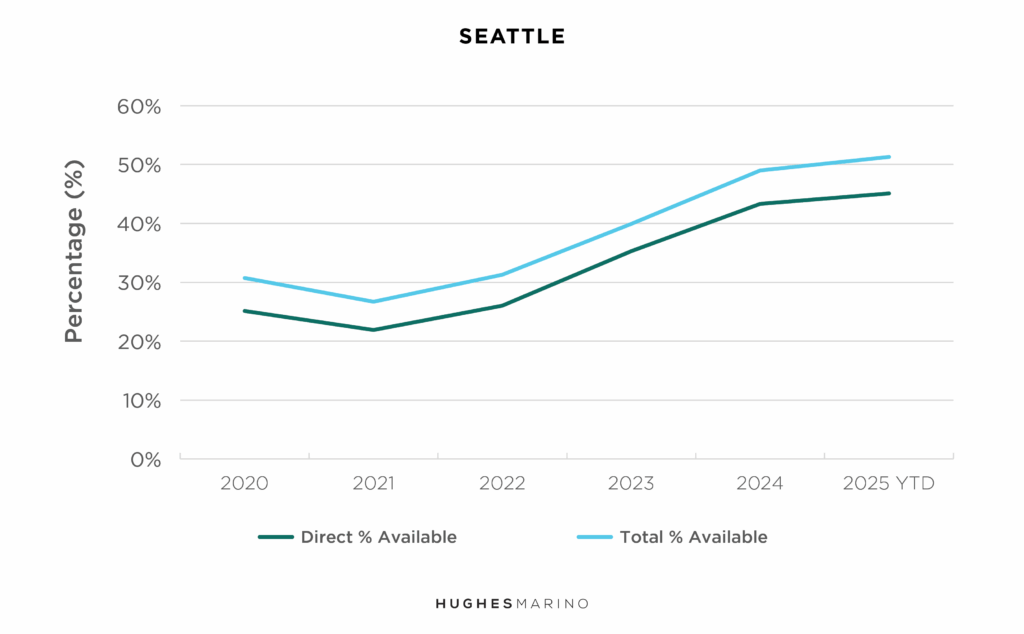
Measuring the market through the tenants’ lens considers all space “available” for lease or sublease in all buildings, even if they are under construction or conversion. Through that “availability rate” recalculation, a very different story was revealed whereby South Lake Union wet lab availability broke into the forty percent range in 2023, and today is 51% for just over 2.2M square feet of available space, which includes over 270,000 square feet of sublease space in 6 subleases from 15,000–84,000 square feet. While these numbers are eye popping, it’s about to get worse for building owners. Alexandria Real Estate Equities amassed roughly 1.3M square feet of flex and office properties in Bothell, WA—anchored by the Canyon Park Business Center and parts of Monte Villa—on the premise they could be converted to lab space. Years later, only a fraction has actually been converted, with much of the space still marketed as office or warehouse due to high conversion costs, infrastructure challenges and uneven demand. Meanwhile, other major life science landlords like BioMed Realty are sitting on significant vacancy as tenants sublease space, downsize or negotiate early terminations. The result is a market awash in available inventory, where landlords face long lease-up timelines and mounting carrying costs—creating one of the most tenant-favorable environments Bothell’s life science sector has seen in years, with flexibility, concessions and aggressive deal terms firmly on the table.
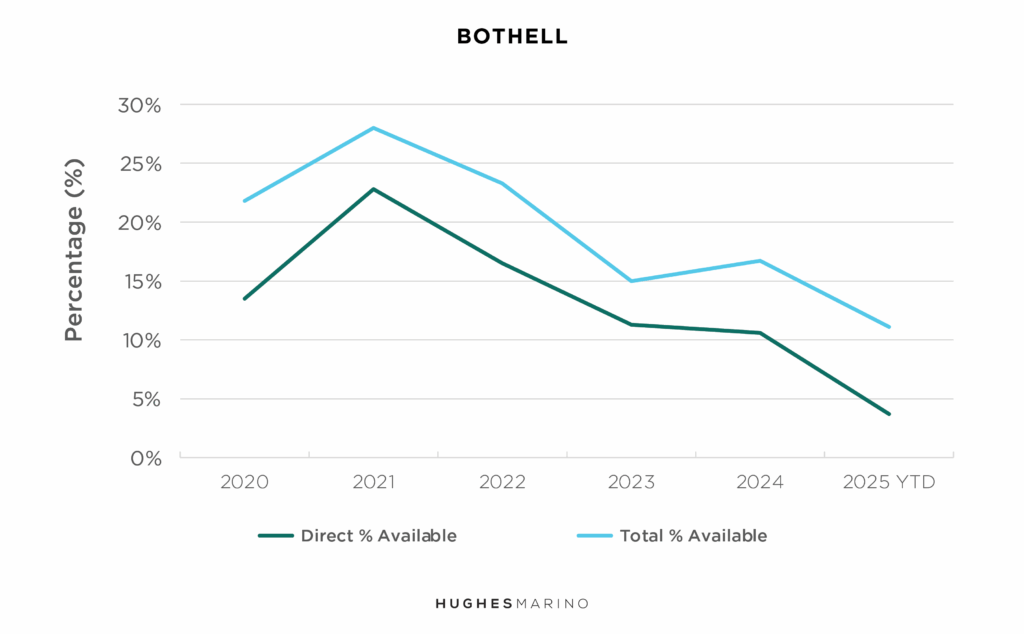
Bothell, WA — How the Value Market is Performing
Looking north to Bothell, the story is similarly staggering. Bothell is the heart of where most of the office-to-biotech lab conversions occurred from 2022-2024, as office and flex space in Bothell was renovated into wet lab space in anticipation of ongoing supply shortages caused by the 2020-2021 wet lab demand surge. Bothell is also the heart of where developers were able to find available land, or low density industrial or office parks that could be torn down and redeveloped into new state-of-the-art multi-story lab buildings, all completed at the same time in 2024-2025. This flood of conversions and new speculative construction is the major contributor to the over 1.3M square feet of available Bothell wet lab space now dragging down the market, which includes approximately 4 subleases ranging from 5,000–50,000 square feet, totaling 100,000 square feet.
None of this includes all of the dozens of available wet lab spaces for lease and sublease in Seattle.
A Historic Supply Crisis Leads to a Tenant Favorable Market
The market has become flooded with options, and just digesting and comparing them is a complicated process. While there are great values for early-stage startup or restart companies of less than 10,000 square feet, the market is particularly soft for larger space, where demand is simultaneously most anemic. If your company needs 10,000-25,000 square feet of wet lab in either Seattle or Bothell today, you have 8 properties that have options available for you in that size range. If you need 30,000-40,000 square feet of wet lab space, there are 4 buildings that can satisfy your requirement. Needing 40,000 square feet or more? There are still 18 building options! Many of these options have been on the market for more than a year, and a surprising number for more than two years, particularly most of the wet lab conversions and new speculative construction.
What can life science tenants expect in the coming years? While landlords and their landlord leasing brokers attempt to maintain the opaqueness and have yet to lower asking prices, lease terms have materially softened for tenants. Rental rates are off by 30% to 40%, free rent is commonly equal to a month per year of lease term and tenant improvement concession packages are whatever is required for the tenant’s build out. More importantly, with the flood of second-generation space and sublease space, tenants can now sign much more flexible commitments from 2-3 years—even on renewals—and don’t have to be tied up in long-term contracts during these times of uncertainty. The critical mistake tenants make is to work “direct” with their landlord or through their landlord’s leasing broker proxy—that is not how you are going to learn what your options are, and what can be crafted and negotiated for you in today’s market. Proven by multiple life science client projects our team is advising on, landlords’ motivations are heightened, and creativity, transparency, independence and leverage rules the day.
Market statistics provided by CoStar Group.