


Why renewal tenants get bad deals & how to avoid it
By John Jarvis
The commercial real estate industry is an inefficient marketplace. It is also a bit of a relic, unchanged in the last hundred years and largely dominated by landlords and their brokers, which has resulted in an industry where long-term, loyal, repeat customers are repeatedly expected to pay a premium. I call it a loyalty premium. The mechanism for this is the renewal option, which unsuspecting corporate tenants use all the time to simply extend the term of their office and industrial leases. It certainly looks like an Easy Button, with language about adjustment to a “market rate.” Except it doesn’t work that way at all. It is a siren song, and you must resist the temptation. Because the spread between “renewal” rental rates and the actual “price-clearing” market rental rates has never been wider than it is today, sometimes by a factor of 2x or greater.
In comparison, the stock market is an efficient marketplace. There are literally millions of active “traders” trading shares of stock every second of every day based on available, public information, continually setting and resetting the market price for those shares. Insider trading in the stock market is illegal, and this enables a certain transparency and levels the playing field for all participants.
Commercial real estate? Not so transparent. Opaque, in fact, is a better descriptor. Consider, there is no publicly available transaction information on negotiated leases, nowhere to find out about the net effective lease economics on current or recent transactions. The landlords know exactly how far they are willing and able to go, but they obviously don’t want that information shared with their tenants. What’s more, the “traders” in commercial leasing—the active participants responsible for setting and resetting the market rental price—are the tenants dealing with expiring leases. Except they aren’t “traders” at all. They are, in fact, quite busy running and growing their businesses, so it’s not surprising that the Easy Button, that renewal option, looks so darn tempting. Resist the temptation.
Today’s market-clearing rental rates can only be discovered when tenants enter the marketplace for vacant space as a free agent and engage in price-discovery negotiations. Even then, not every building owner can afford to meet the market today. In San Francisco, for example, numerous Class A office projects have now completed the reset cycle of foreclosure and resale to professional investors. And it’s these new investors who are driving the market and competing for (and winning) the relatively few active requirements, because they have fresh capital and a property basis reduced by 60% or more. These are the folks who can afford to sharpen their pencils, and these are the folks making the market today. So as a tenant, you need to get in the game and trade paper with these market-makers. This is how you will gain visibility to today’s market-clearing rental rates.
Your current landlord, of course, doesn’t want you to do this, and they certainly don’t want you to know all of this. Your landlord desperately wants you to exercise your renewal option. They may even proactively reach out and offer a modest discount or concession. For some owners, this is the only way they make it through the current market cycle, if enough of their existing tenants simply exercise their renewal options and end up paying inflated rates.
To put it into perspective, as a landlord, losing you as a tenant means…
- It could take up to two years to find a replacement tenant.
- The replacement tenant will likely require a substantial tenant improvement allowance upon signing the new lease.
- The landlord will have to cover all of the property expenses during the vacancy.
- The replacement tenant could be irresponsible and fail to pay rent.
Given all these risks, it’s clear that having a reliable, long-term tenant matters more than ever to a landlord. You’ve consistently paid rent on time and have been a stable presence in the building. That kind of dependability should count for something.
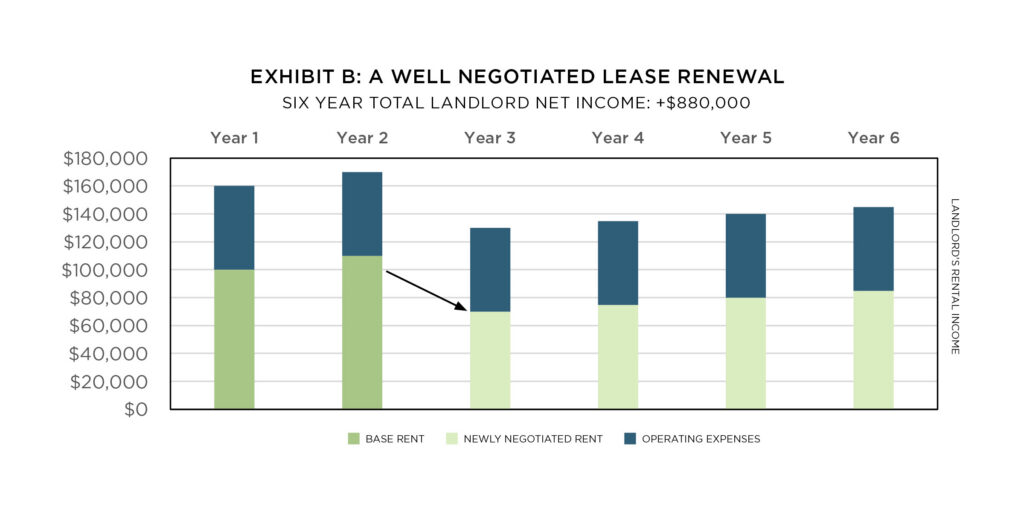
In fact, when you break it down, the numbers strongly favor keeping a trustworthy tenant like you, especially with a fair, well-negotiated renewal. The charts below lay it out clearly: a comparison of what it costs a landlord to lose a tenant versus the value of retaining one.
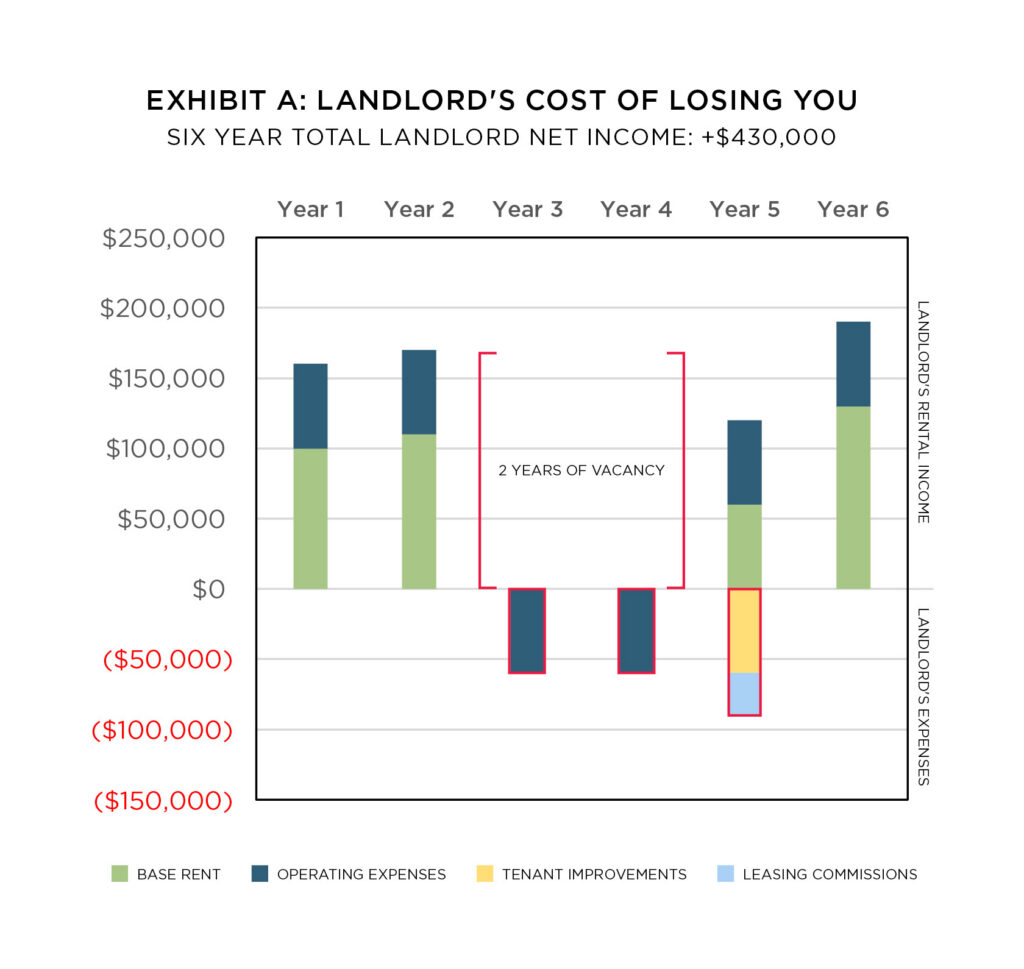
EXHIBIT A: For years 1 & 2, your landlord continues to receive rent checks to cover the mortgage, property taxes, maintenance, utilities, etc.—profit for themselves.
Years 3 & 4: The property now sits vacant, and your landlord is hemorrhaging massive expenses, often putting them in noncompliance with its loan covenants, putting the building at risk for foreclosure.
Years 5 & 6: After months, possibly years of vacancy, assuming the landlord is successful at finding a replacement tenant, they will need to fund a substantial tenant improvement allowance to provide a space that works for the new replacement tenant. The new tenant may/may not have reasonable financial strength, which could devalue the building in the event of a future sale, adding to the financial pain of losing you. In this scenario, the landlord nets $430,000 after the vacancy, but could have made $880,000 (shown in EXHIBIT B) over the same period if they had lowered the rent by 30% and kept you, their long-term tenant in the building.
As in most areas of life, there are simply no shortcuts without consequences. And that Easy Button? It’s a shortcut to the loyalty premium, every time.