
Key Takeaways
- Denver industrial availability hit an all-time high of about 15.4% in 2026, more than double the 7.3% of 2016 and nearly 70% above pre-Covid levels.
- Asking rents of $10.20/SF are down only 6.6% from their $10.92/SF peak and remain 25% above pre-Covid rents of $8.16/SF.
- Rents are “sticky” because landlords share pricing through the brokerage community, lenders and investors resist cuts, and owners give concessions instead of lowering asking rents.
- Our advice: don’t accept asking rents at face value. Test the market, including the growing number of subleases, with an advocate like Hughes Marino who works only for tenants.
By now, you as a business owner or operating executive in metro Denver can likely sense that industrial real estate here is softer than it’s been in years. But how soft is it really for building owners? Ten years of data on Denver’s industrial availability (including space under construction not yet vacant and sublease space) and asking rents pull back the curtain on what is actually happening in this market.
What 10 Years of Denver Industrial Data Show
Historically, industrial markets are supposed to behave rationally: as availability rises, asking rents should fall, and vice versa. But since 2021, the Denver industrial market has increasingly violated that basic economic logic:
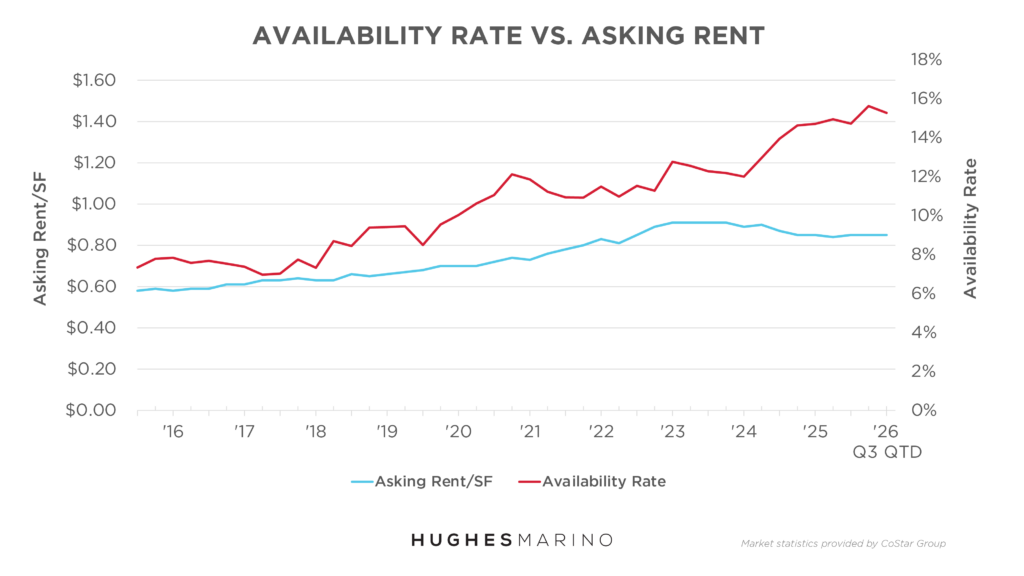
- Availability has climbed in eight of the last ten years, moving from 7.3% in 2016 to over 15% today (more than double) with no sustained pullback in sight. It just posted a new all-time high in the first and second quarters of 2026 and has held near that level since.
- Even as availability rose nearly 70% from its pre-Covid (first quarter 2020) level of roughly 9.1%, landlords and their brokers continued to raise asking rents for over three more years, peaking at $10.92/SF between the third quarter of 2023 and the second quarter of 2024.
- Today, availability sits at an all-time high of roughly 15.4%, which is 39% above where it averaged in 2022, yet asking rents have slipped only 6.6% from their peak. Worse, today’s rent of $10.20/SF is still slightly higher than the $9.66/SF landlords were asking back in 2022, despite significantly more available space on the market.
- Rents today remain 25% above pre-Covid 2020 levels ($10.20/SF vs. $8.16/SF), even though availability is up nearly 70% over that same stretch.
If the market is this tenant-favorable, why are tenants still expected to pay near-peak rent? Why are landlords sitting on an availability rate more than double what it was a decade ago, yet asking prices have barely moved off their all-time highs?
How Prices Are Set
Landlords don’t coordinate pricing, but they do share a tremendous amount of information through the brokerage community and anchor off each other’s pricing. With the Denver brokerage community largely working for landlords, or too frequently acting as dual agents representing both landlords and tenants in the same transactions, landlords have full transparency into what their competitors are doing in real time. Brokers publish almost every lease transaction within their own internal databases. Those databases are then shared across their entire brokerage firm, traded with other brokers and shared with other landlords those same firms represent. Tenant lease terms circulate widely, and Denver landlords generally know who’s completing transactions and at what terms.
Brokers Price-Support the Market
The brokerage business was built over a century ago to provide leasing, property management, investment sales, capital markets, appraisal and any other imaginable service a building owner or developer might need—not to represent tenants in a transparent or independent way. Over time, serving tenants became a byproduct of those core landlord services, all while commercial real estate brokers simultaneously helped support landlords with their pricing and valuation objectives.

Yes, that representative who does the building’s leasing always knows what’s available, but their much larger and longer-term core customer is the building owner, and they aren’t going to work against that relationship to get the tenant the best rates possible. They cannot aggressively test their own landlord’s marching orders or bottom line when market conditions deteriorate. Worse, the tenant working directly with the landlord or through the landlord’s listing team has no leverage, no legitimate relocation options and little real information about what can truly be done in that building or elsewhere. For building owners and their brokers, it’s all about holding the line to maximize the value of the real estate, which comes through monetizing tenants’ rent streams. In that model, tenant rent streams are valued primarily for what they do for the asset.
Lenders and Investors Sometimes Set a Floor
Beyond the owners and landlord brokerage firms that set prices and support them, there’s a structural problem that prevents landlords from simply lowering rents, even if they wanted to. Most commercial real estate buildings have outside investors and debt, often requiring lender approval on leases. Those investors have been promised a certain return and are slow to accept price reductions. When the market softens, some landlords simply maintain their pro forma asking rents or now advertise their space as “withheld” or “negotiable,” while offering significant free rent packages, lease assumptions and other financial concessions necessary to keep or win tenants, all without ever lowering their posted asking price.
The Role of Price Stickiness
Price stickiness occurs when market prices resist change despite a major oversupply of the underlying product. As a business leader or owner, you’ve likely experienced this in other areas. The costs of labor, insurance and shipping all respond quickly to upward pressure but are very slow to recede. Denver landlords and their brokers were able to charge historically high prices of roughly $10.80-$10.92/SF for warehouse space during the 2023-2024 window. Now, with availability at an all-time high and still climbing, many are still pricing to those levels, and getting the market back down toward its pre-Covid range of $7.80-$8.40/SF faces massive structural and psychological resistance, as the asking rent has barely budged in two years, sliding only to $10.20/SF even as available space has grown by roughly a third.
Where It Ends and What to Do
What all of this means for tenants is that you can’t take landlords’ asking prices at face value, nor the brokers who are promoting them as a “market comp” anchor to push tenants into mediocre leases. The Denver industrial market is far more favorable to tenants than most business owners and executives realize. Availability in 2026 has hit a new all-time high, and asking rents have moved only marginally off their peak. But you have to get into the market and test your options to force a genuine process of price discovery, including looking at the growing number of sublease opportunities, rather than assuming asking rents reflect the market you are actually in. That requires a dedicated advocate who acts only on behalf of the tenant and doesn’t work for landlords or a full-service brokerage firm whose business depends on building owners in an industrial market that is, by the numbers, squarely in the tenant’s favor.
That’s the only way we work. Hughes Marino specializes in representing tenants and buyers, not landlords, with no conflict of interest. If you lease industrial space in metro Denver, talk with our team before your landlord’s asking rent becomes your starting point.
Frequently Asked Questions
Denver industrial availability is roughly 15.4%, an all-time high set in the first half of 2026, including space under construction, not yet vacant and for sublease. It has more than doubled from 7.3% in 2016 and is nearly 70% above its pre-Covid level of about 9.1%.
Denver industrial asking rents average about $10.20/SF, down only 6.6% from their $10.92/SF peak between late 2023 and mid-2024. That is still 25% above the pre-Covid 2020 level of $8.16/SF and slightly above the $9.66/SF landlords asked in 2022.
In our experience, three things hold rents up: landlords anchor off each other’s pricing through information shared in the brokerage community, lenders and investors resist cuts that hurt promised returns, and prices are “sticky” on the way down. Many landlords give free rent and other concessions instead of lowering posted asking rents.
Before Covid, Denver warehouse rents ranged from about $7.80 to $8.40/SF. Landlords charged historically high rents of roughly $10.80–$10.92/SF in 2023 and 2024, and many are still pricing to those levels.
Don’t take asking rents at face value. Test the market to force real price discovery, including the growing number of sublease opportunities, and work with an advocate who represents only tenants. Hughes Marino specializes in representing tenants and buyers, not landlords, with no conflict of interest, so there’s no landlord relationship to protect when we negotiate for our clients.
Market statistics provided by CoStar Group.