

The Seattle region’s industrial market has shifted decisively in tenants’ favor. Regional vacancy rose to 10.4 percent in the third quarter of 2026, up from 8.9 percent at year-end 2025, and availability, the space actually being marketed for lease and sublease, is running higher still. For occupiers who spent the past several years negotiating against tight conditions and thin options, this is one of the most favorable environments we have seen in years.
At the same time, the development pipeline that fed the last cycle has thinned dramatically. Inventory is still growing in the near term as projects already underway deliver, but with new construction starts down roughly 3M SF year over year, the supply coming after that has slowed to a trickle. That tension defines the market today. Conditions are soft now, but a shrinking supply of future space sets up a much tighter market once demand returns.
One Region, Very Different Submarkets
The regional average hides how uneven conditions have become. Vacancy has risen almost everywhere, but the pace and the pain are not evenly shared.
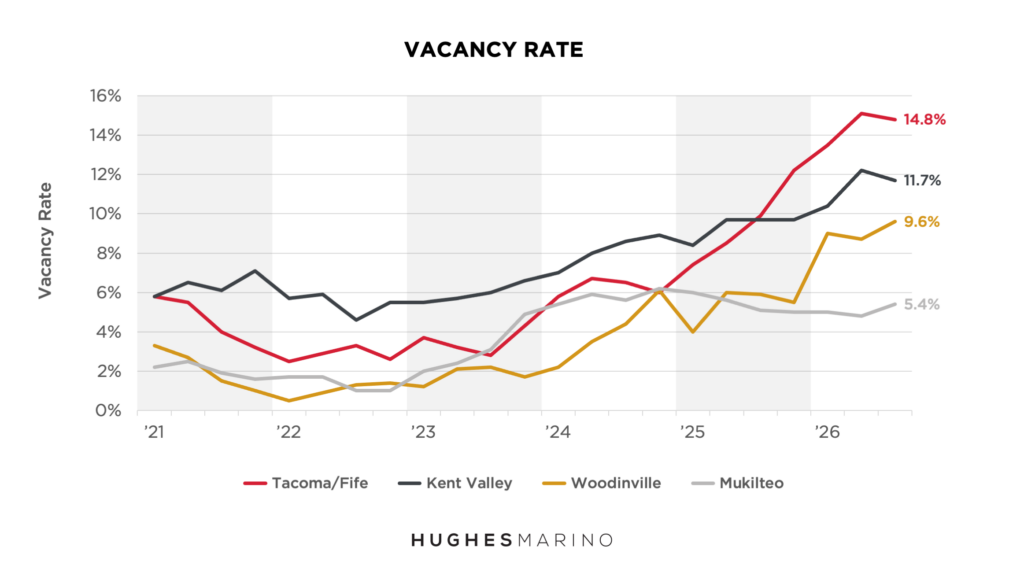
The softness is concentrated in the south. The Kent Valley, long the backbone of Seattle distribution, and the Southend around Tacoma and Fife carry the highest vacancy and the deepest concessions. Tacoma and Fife now sit near 15 percent vacant with availability approaching 19 percent, the widest gap in the region and a clear sign of how much space is being marketed ahead of actual move-outs. The Eastside has held up better, but it is not immune. Limited inventory has kept occupancy losses in Woodinville and the broader Eastside modest, and asking rents there remain the highest in the region. Even so, Woodinville vacancy has climbed from 5.5 percent at year-end 2025 to 9.6 percent, the largest increase of any submarket we track. Farther north, Mukilteo and the Snohomish County submarkets are the tightest of all, with vacancy and availability both at 5.4 percent.

Measuring the market through availability rather than vacancy, the way a tenant actually experiences it, the gap between the two is a useful early signal. Where availability sits well above vacancy, as it does most sharply in Tacoma and Fife, more space is on the way even before it shows up as empty.
Asking Rent Growth Has Cooled, but Effective Rents Keep Falling
Asking rent growth across the region has cooled to roughly 3 to 5 percent year over year, down from annual gains of 6 to 8 percent in 2022 and 2023. The more important movement is happening beneath the asking rate.
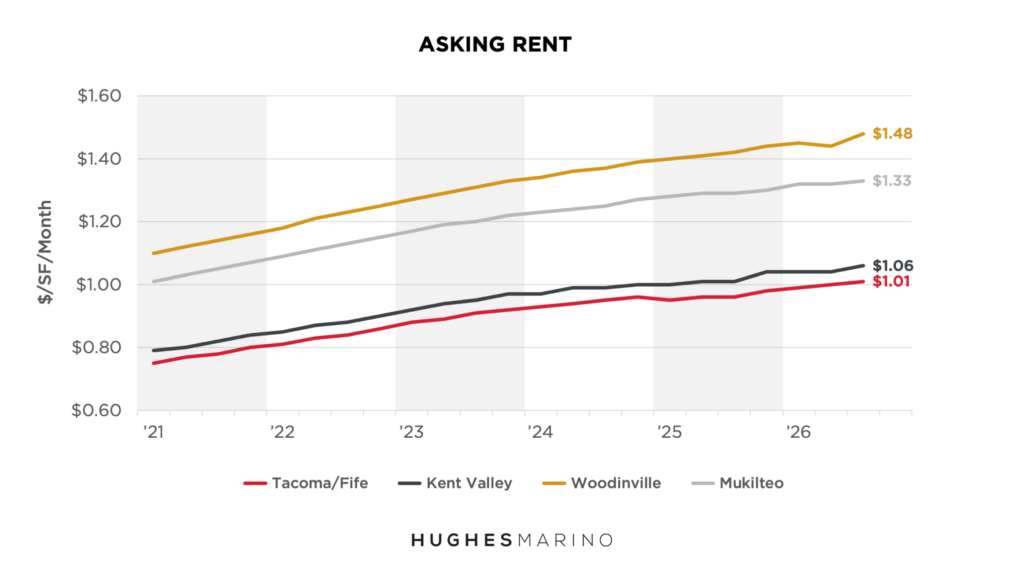
To secure occupancy in a market this soft, landlords are layering on free rent, larger tenant improvement allowances and other concessions. Effective rents, what a tenant actually pays over the life of a lease, continue to decline even as the quoted number edges up. Class A product is holding up better than older space, but concessions are on the table across the board.
Muted Demand, Softer Cargo and Big Blocks Returning
Large block leasing activity remains muted, and what is happening is driven mostly by renewals rather than expansion. Net absorption has turned negative across much of the region over the past year, with the steepest occupancy losses in the Kent Valley as large distributors and freight users give back space. The south did show early signs of stabilizing in the third quarter, with positive absorption in both the Kent Valley and the Southend, enough to turn the Southend’s trailing 12-month total slightly positive.

Those departures matter. The big, well-located blocks these users leave behind are among the most valuable in the market, and they are now available to tenants who could not have touched them a few years ago. Underlying demand is being held back by forces outside the region’s control. Ongoing tariff uncertainty and softer cargo volumes through the Northwest Seaport Alliance continue to weigh on warehouse requirements, and core cargo activity remains down.
Aerospace and Defense Step into the Big Blocks
The clearest signal of where the next wave of demand is coming from showed up late in the third quarter, when several of the quarter’s most significant new leases went to aerospace, defense and space users. Cowboy Space leased 291,035 SF at 7650 S. 228th St. in Kent, where it will convert the building to manufacturing for space and rocket hardware and bring about 300 jobs. In Everett, Amazon took 91,000 SF for its Leo satellite division. Other significant large-block deals have also been completed in SeaTac.
These deals are significant beyond their size. Advanced manufacturing and aerospace-related users are driving some of the most active requirements in the market, with demand for blocks ranging from 300,000 to 700,000 SF improving considerably. The Cowboy Space lease is a good example of this shift, taking a second-generation Kent Valley distribution facility and converting it to long-term manufacturing use, effectively removing another large block of space from the market.
For tenants, the takeaway is straightforward. Many of the large, well-located facilities that provide leverage in today’s market are also being targeted by advanced manufacturing and aerospace users. These groups are competing for many of the same building features, including heavy power, high clear heights and sufficient yard space for secure operations. While tenants still have meaningful leverage today, those with large-format requirements should not assume the same selection of quality options will be available heading into 2027.
A National Landlord Confirms What We See Locally
The softness is not just a local read. On recent earnings calls, Prologis, the largest industrial landlord in the country, has pointed to Seattle as one of its softer markets even as it reported exceptionally strong national results. When the biggest owner in the sector names your market among its softest, it reinforces what our team is negotiating firsthand every day. Seattle is one of the most tenant-friendly industrial markets in the country right now.
What This Means for Tenants
In most of the country, leasing activity is starting to pick up. As it does, landlords regain the upper hand, and the free rent and other concessions tenants can win today begin to disappear. Seattle is expected to stay behind that curve. The region has more empty space to work through, and with port volumes soft and tariffs still a drag, its high vacancy and tenant-friendly deal terms should hold into 2027.
For tenants, that delay is the opportunity. While landlord leverage stays limited, now is the window to pursue early lease restructures, renewals or relocations and to lock in terms that will be far harder to win once space starts filling again and landlords get their pricing power back.
That window will not stay open forever. Very little new construction is starting today, and aerospace and defense users are already absorbing some of the largest blocks. A short supply of available buildings is exactly what pushes vacancy back down and hands leverage to landlords. The tenants who act now, while options are plentiful and concessions are generous, will be in a far stronger position than those who wait.
The costly mistake is to navigate this market alone or through the landlord’s representative. Understanding the full range of options, and what can be structured and negotiated in today’s conditions, is where independent tenant representation earns its value.
Market statistics provided by CoStar Group.