
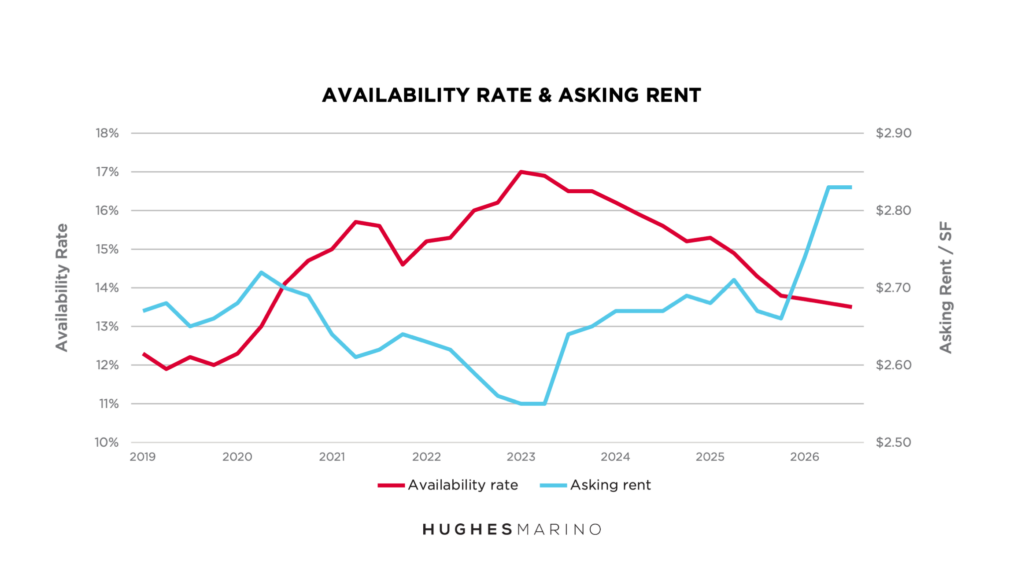
For six years, Orange County office tenants have had the luxury of time. Availability climbed from 12.3% in early 2020 to a peak of 17% in early 2023, and a tenant who waited another quarter usually found a better deal waiting. That has stopped being true.
Availability has fallen to 13.5%. Asking rents are up roughly 11% off their 2023 trough. Sublease space, the clearest sign of a market with too much room in it, has dropped 37% in under three years. The market has tightened, and the reason it tightened is the reason it is unlikely to loosen again any time soon.
Orange County has Stopped Adding Office Space
In two and a half years, Orange County has added no new leasable office space at all. Looking at what has been delivered, the focus has not been on traditional office space. Twelve buildings have been delivered since 2024, and not one of them is a multi-tenant office building a conventional tenant could lease. Eight are medical office. Two were built for owner occupants or as build to suit. The two remaining are a medical building and an office condominium sold by the unit.
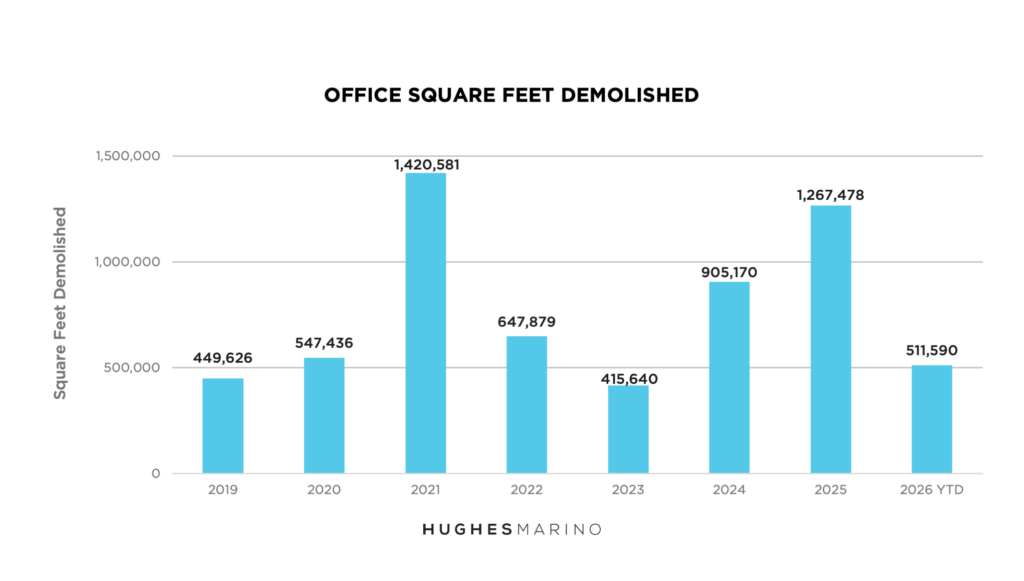
Supply hasn’t just stalled at the top, rather it’s shrinking from the bottom. Between 2020 and mid 2026, 5.6M SF of Orange County office has been demolished, about 3.6% of the county’s 157.4M SF office base in 2020. Some estimates suggest another 4M SF is planned for conversion or demolition, which would bring the combined reduction to roughly 6% of the pre-pandemic base.
And the Next Round is Already Entitled
This is not just a pause in construction. Buildings are leaving the leasable market permanently, and the projects moving through Orange County city halls show where the next reductions are coming from.
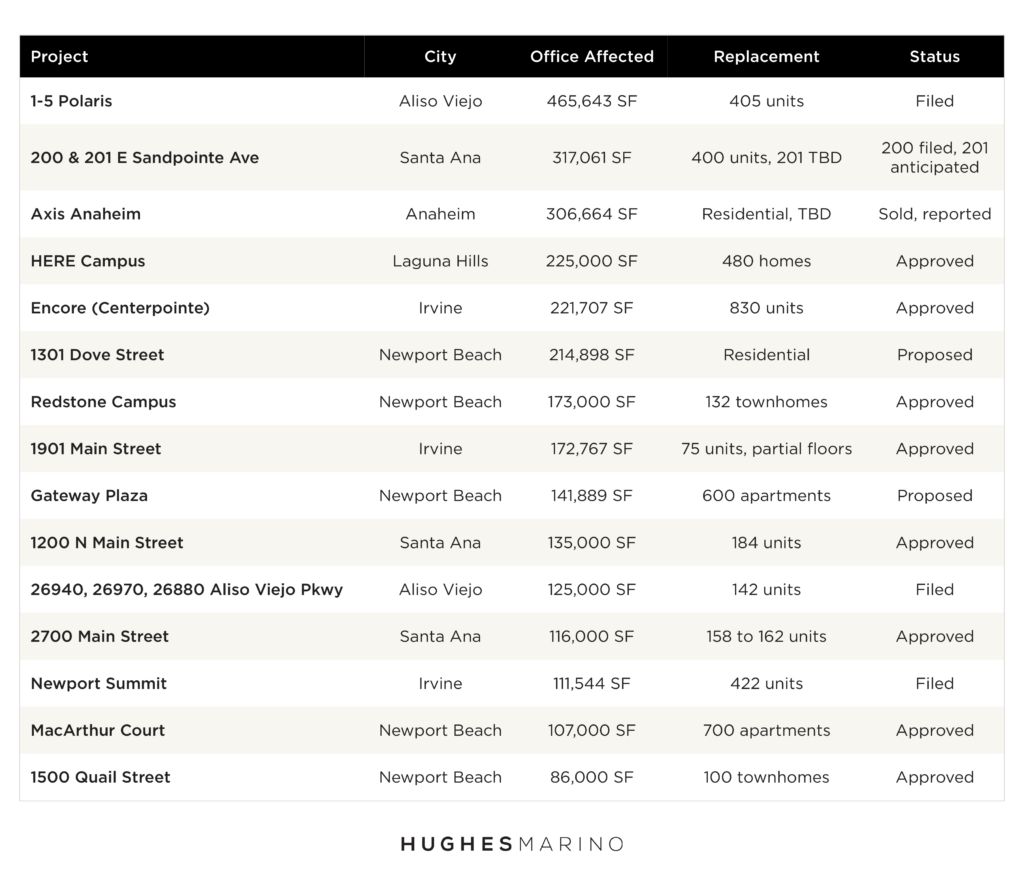
Together these projects account for more than 2.9M SF of Orange County office buildings, and city records show office to housing conversions underway at five separate addresses on Dove Street.
This is Not a Demand-Driven Recovery
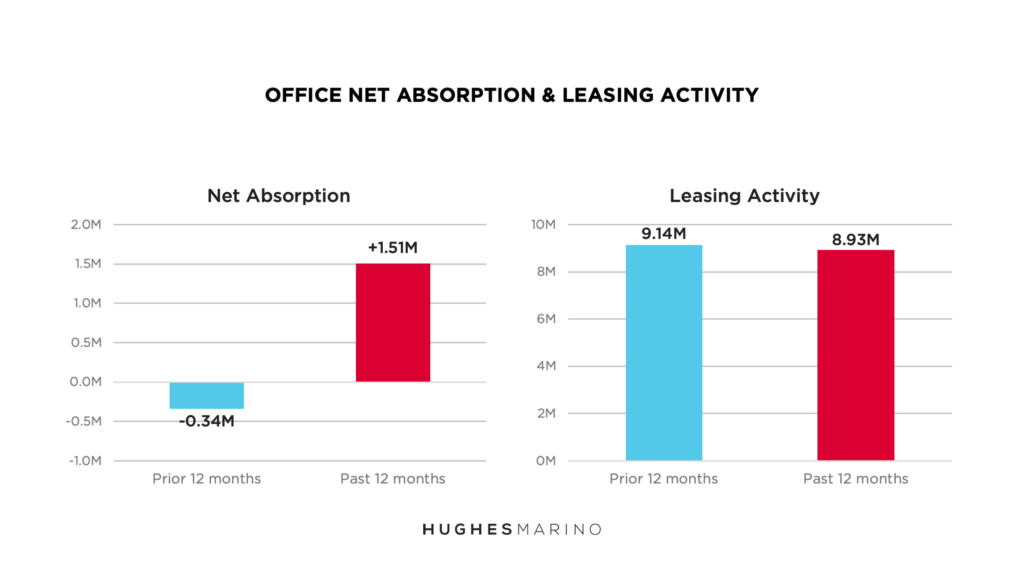
Landlords have started quoting improved absorption. Net absorption over the past 12 months came in at a positive 1.7M SF after four negative quarters, and occupancy has improved from 86.7% to 89.1%.
The figure does not survive scrutiny. Nearly half of it landed in a single quarter. Over the same 12 months, leasing activity fell 2.3% in square footage and 1.2% in deal count, and average lease size has been flat to declining. Tenants are not signing more leases, or larger ones. Much of that space was absorbed by tenants relocating out of buildings slated for redevelopment. The same demand is moving between buildings, rather than new demand entering the market.
The Reported Numbers Understate How Tight This Is
Availability has fallen across every major submarket. The Stadium Area has come down from a 21.4% peak to 15.9%, Irvine Spectrum from 20% to 15.5%, and the Airport Area from 18.9% to 14.1%.
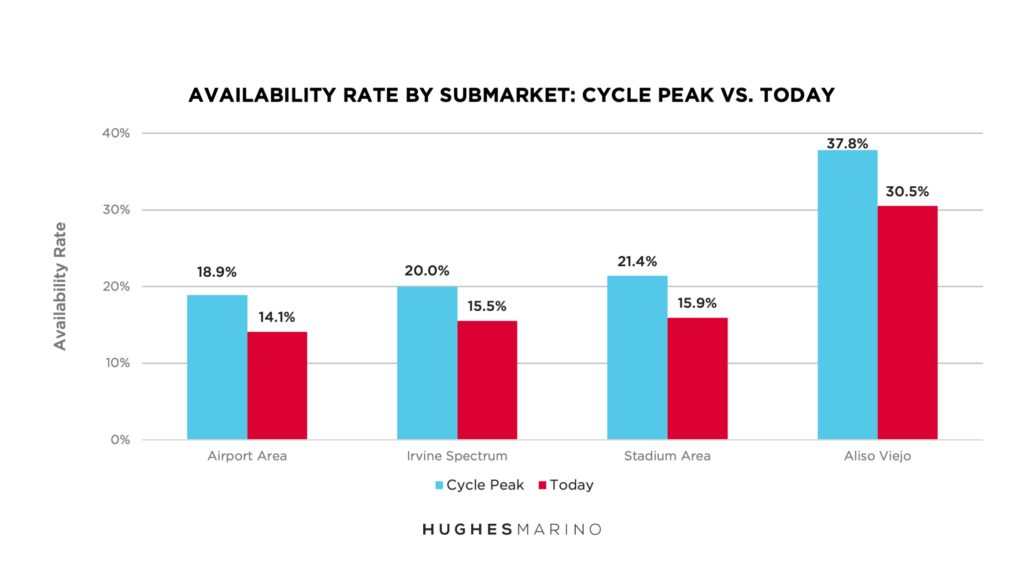
Aliso Viejo looks like the exception at 30.5%. In practice it is the clearest evidence of how far the data lags reality, because several buildings still counted as available have already been emptied ahead of redevelopment. That space will never return to the leasing market, but it stays in the availability figures until the buildings come down. The same is true countywide, which means 13.5% overstates what a tenant can actually lease in Orange County today.
Nothing is Coming to Replace It
Orange County has 194,000 SF of office under construction, down from 1.75M SF in mid 2020, and construction starts over the past 12 months totaled zero. One building, The Weave at ocV!BE in Anaheim, accounts for 87% of that pipeline, and it does not deliver until late 2028. The other four projects total 25,587 SF combined, and two of those are medical.
What This Means for Tenants
Softness has not disappeared from Orange County, but it is no longer a market condition. It is now specific to individual submarkets, and increasingly to individual buildings. That makes understanding a landlord’s strategy more important than it has ever been, for two reasons. It protects a tenant from committing to a building that may be headed for redevelopment. And it identifies where genuine negotiating flexibility still exists, because it is no longer evenly distributed.
Ownership matters more than it used to as well. Buildings that have traded to private, long-term holders rather than developers came with a low-cost basis, and those owners can compete on price in ways an institutional landlord carrying a higher, pre-pandemic basis simply cannot.
Consolidation is happening across the county in real time, and every displaced tenant becomes a competitor for the space that remains. Tenants with leases expiring in the next 24 to 36 months should be starting those conversations now. Six years of favorable timing taught Orange County tenants to wait. The market that rewarded that instinct is now gone. Tenants no longer hold uncontested leverage, and the smart move now is to act before rents catch up to the shrinking supply.
Market statistics provided by CoStar Group. Development activity per city planning and entitlement records.